
Workforce innovation in the UK social care sector: an update on our inquiry
We are glad to share with this post some results of our inquiry on the extent and nature of social care workforce innovation in the UK. In doing this, we would like to thank all those who contributed to identifying promising activities and initiatives, by providing information and inputs.
Tracing the extent and nature of workforce innovation in the UK: what we did
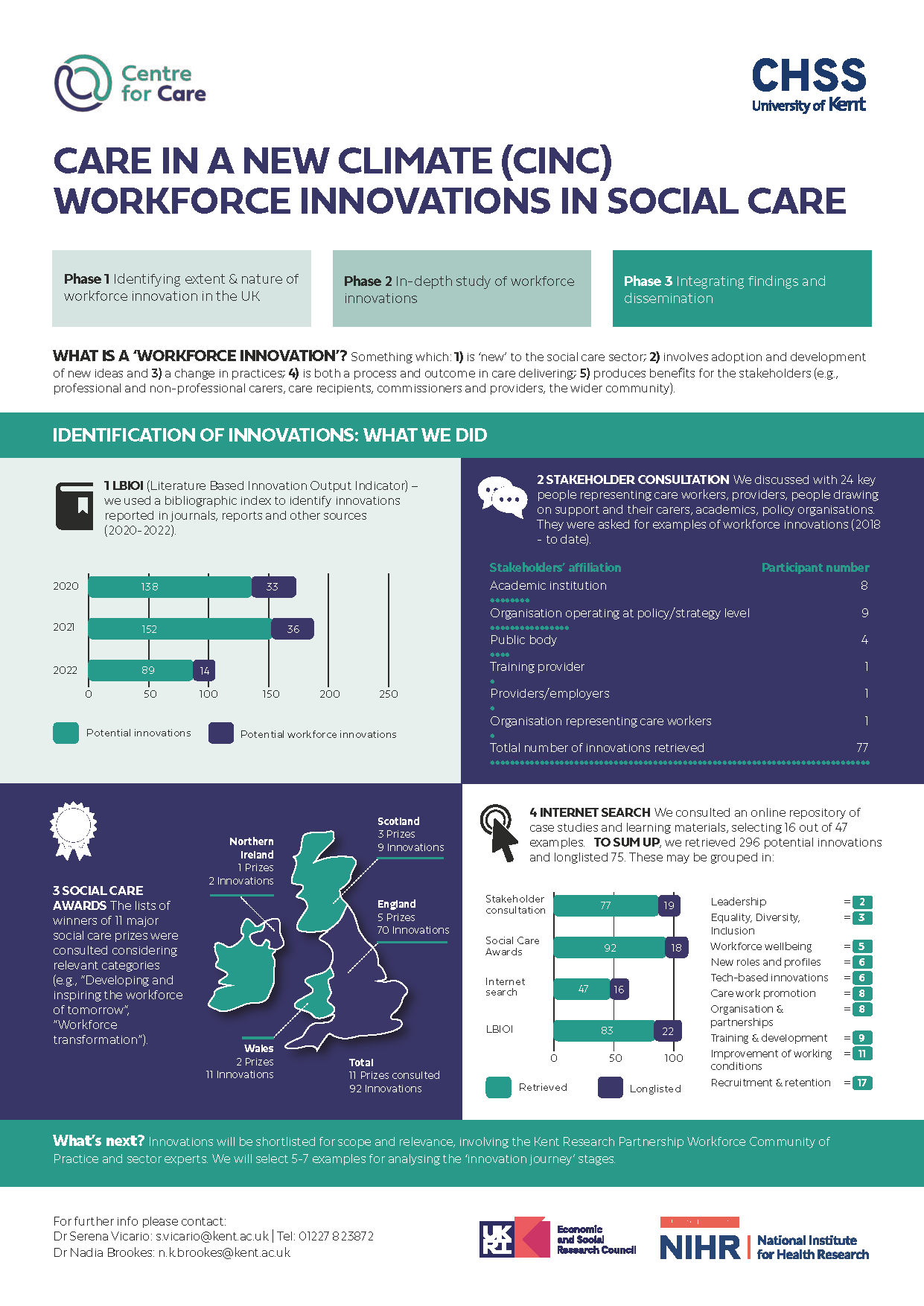
As the graphic representation illustrates, we located workforce innovations in the sector literature, and examined temporal trends and innovation types. Between 2020 and 2022, 83 potential innovations were retrieved (33 in 2020, 36 in 2021, 14 in 2022).
We also discussed the topic of workforce innovation with 24 key people representing different voices in social care. They were affiliated to 15 national and local organisations in England, Scotland, Wales and Northern Ireland. Participants were involved through online or in-person interviews and suggested 77 potential new practices and initiatives. These stakeholders also provided insights into future workforce challenges, and on the role that innovation may play in addressing these. Although the lack of sufficient resources was considered a central issue, innovation was seen as important to meet existing needs differently.
Following the suggestion of a stakeholder, we consulted the lists of winners of 11 major UK-based social care prizes. The search located 92 award-winning individuals or initiatives.
Finally, we conducted an online search of accredited internet websites. Forty-seven projects were examined, considering their innovative elements.
In total, approximately 300 potential innovations were screened, and 75 were longlisted for scope and relevance. Similar innovations were grouped into ten clusters, including for example ‘Recruitment and Retention’, ‘Improvement of working conditions’, ‘Workforce support and wellbeing’, ‘Technlogy-based innovations’ and ‘Innovation through partnership building’. Further selection rounds have been informed by discussions with key stakeholders, including the Kent Research Partnership Workforce Community of Practice and sector experts. We would particularly like to thank Skills for Care for taking the time to do this with us. This helped us to identify 5 promising innovations for in-depth study.
What’s next?
Innovations will be analysed in-depth. We will look at the stages of the innovation ‘journey’ – from the identification of the initial need, to the development and implementation of the new approaches. In doing this, we will consider the innovations in their contexts, and examine the resources and strategies useful to achieve sustainable and long-term change.
And in the meantime, we will keep you informed on how our work is progressing…
About the authors

Serena is a Postdoctoral Researcher Associate affiliated to the ESRC Centre for Care and based at the University of Kent, Centre for Health Services Studies. In her current role of qualitative researcher in the Centre for Care team, Serena is working on the project ‘Care workforce change’.

Nadia joined the Personal Social Services Research Unit (PSSRU) at the University of Kent in 2008 and moved to the CHSS in 2020. Prior to joining the university she held senior research roles within central and local government, the health service and the non-profit sector. Nadia has an MSc in social research and evaluation and a doctorate in social policy that focused on the extent, nature and process of innovation in adult social care.
More commentaries

Dr Duncan U Fisher and Professor Liam Foster examine the Health and Social Care Secretary’s recent announcement on creating a National Collective Pension Scheme.
Read More about The National Collective Pension Scheme: a better future for social care workers?
Centre for Care Impact Specialist Fay Benskin reflects on the key topics around care that emerged during the Labour Party 2026 conference.
Read More about Shaping the Future of Care: Centre for Care reflections on this year’s Labour party conference
A guest commentary from our wonderful Summer School 2026 attendees! They reflect on their time with us in Sheffield sharing key takeaways from the week-long event.
Read More about What happens when care scholars come together? Reflections from the Centre for Care 2026 Summer School
Dr Maria Petrillo attended a Eurocarers Research Working Group meeting and conference in Kraków, Poland. Read her account of the trip here.
Read More about Connecting care research across Europe: CIRCLE at the Eurocarers Research Working Group in Kraków