Care Trajectories and Constraints
We explore what needs to change to better support people who require, receive and provide care as they transition through the life course and as they move across international borders.
In this Research Group, we are studying how care experiences are affected by changes. These include changes across people’s lifetimes as they move through the life course and changes as a result of people migrating across international borders. We want to understand how these past and current events contribute to shaping experiences of care for different groups of people, including, for some, in negative or unequal access to care. The knowledge gained is supporting us to make recommendations for policy and practice to better support people’s wellbeing through the provision of ‘good care’.
We understand care as something that all human beings need and provide. We are also concerned with situations in which care is needed but not received. We look at care and the caring relationships provided formally (for example, by paid care workers) and informally (for example, by family members and neighbours). We are also interested in care provided and received not only by individuals, but also collectively, for example, the group support provided by community organisations.
There are two main strands to the work of the Care Trajectories & Constraints Research Group:
Strand 1
“Borders & Care”, examines the care needs of people with experiences of migration. The research asks how people in the UK with migration backgrounds are experiencing care today, and how this has changed over their lifetime. We examine how and why experiences of migration, including engagement with the UK’s migration system, might cause people to receive different levels or quality of care. We also examine people’s experiences of care when family members live in different parts of the world. From the research results, we are developing recommendations on how public services and laws need to change so that the care needs of people with experiences of migration are recognised and met.
Strand 2
“Transitions & Care”, examines how different life changes affect people’s experiences of care. The research asks what changes through people’s lives have affected their care, and how they have experienced this changing care support. We are speaking to people who have been through different life changes such as moving from children’s to adult services. We also looking at the life changes that are experienced by children and young people who care for family members. From the results, we are developing a clearer understanding of which transitions matter most to people and how these can be experienced more positively.
Key output: Migration and the right to care

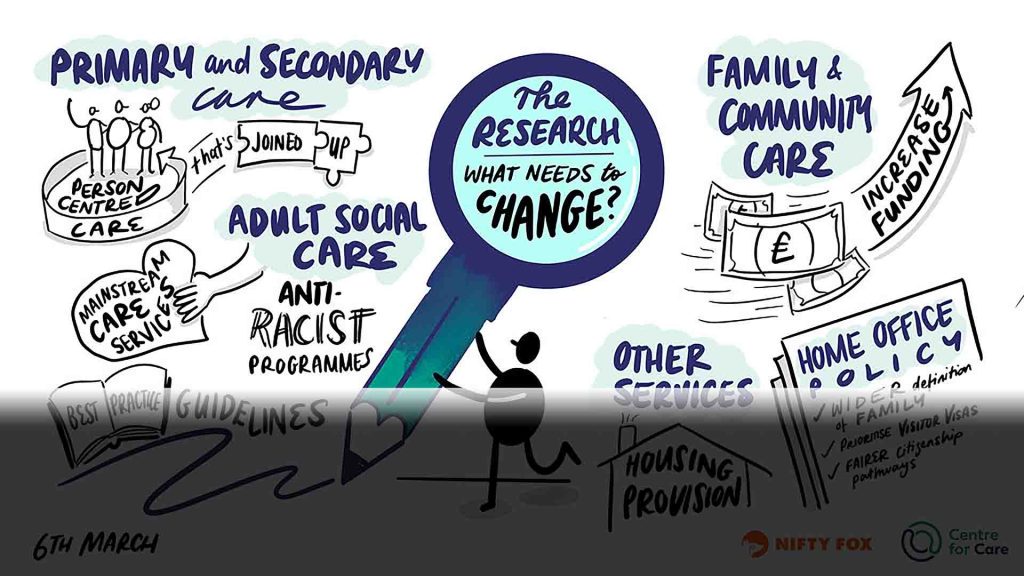
Research undertaken in the “Borders & Care” research strand led to the publication of the ‘Migration and the Right to Care’ report, summarising the research findings and setting out recommendations for change. The research was undertaken between 2023 and 2024 by Dr Jayanthi Lingham (Centre for Care Research Associate) and Professor Majella Kilkey (Centre for Care Co-Investigator), in collaboration with project partners, SADACCA (Sheffield and District African Caribbean Community Association) and Stand as One.
The research explored the care experiences and needs of older people (aged 50+) with histories of international migration now living in the UK, and those in care relations with them. Participants included post-World War II labour migrants from Caribbean and African countries formerly colonised by Britain, and people from East Africa, dispossessed by postcolonial conflict, who arrived through a UK-UNHCR refugee resettlement scheme. The research involved three rounds of individual oral history sessions, incorporating drawing as an arts-based method, with 11 migrants aged 50+ spanning the two groups, and 23 semi-structured interviews with people in unpaid and paid care relationships with them. The research sought to understand people’s care trajectories across their life courses, through processes of migration, and the role of structural conditions in mediating access to, and wellbeing through, care.
Overall research findings can be grouped into the following themes:
- Care relationships and needs are global
- Migration histories and experiences shape care needs today
- ‘Good care’ is multi-relational
- The importance of connected health and social care systems
- The role of racism in damaging health and undermining care
- The role of economic marginalisation in increasing health and care needs
Based on the research findings, the report advocates for the right to both receive and provide good care. It adopts a holistic understanding of care that encompasses statutory service provision and crucial household, kin and community support networks, including globally separated one. The reports sets out a range of recommendations for change in public services and policies, in order to better meet the care needs of older migrants. These are addressed at:
- Adult social care services
- Other government statutory services that affect care
- Home Office policies that affect care
- Family and community care
- Primary and secondary health care services
Podcast mini-series: How Language Matters
In this series, the Borders and Care team look at questions and themes such as:
- How complex or shifting language within the care system can act as a barrier to services.
- Is focusing on language a distraction from addressing systemic issues like underfunding and inequality?
- How language can draw attention to invisible forms of labour and care.
- The impact of words like “dependency” in framing people as passive rather than interdependent.
The Transitions that Matter commentary series
The word transition is a familiar one within social care, usually used to refer to the move from children to adult care services. This is known to be a critical and problematic juncture, with a lack of connectivity and resultant gaps in support.
In the ‘Transitions’ strand of the ESRC Centre for Care we are exploring all of these forms of transition, in dialogue with people with lived experience about which transitions matter, why and how. The aim is to understand the role of transitions across the lifecourse in shaping people’s experiences of care and their wellbeing, and how these can be improved.
Click here to read more about The transitions that Matter commentary series.
Commentary on Care Trajectories and Constraints
Commentary pieces relating to Care Trajectories and Constraints

Jayanthi Lingham and Majella Kilkey explore the UK government’s recent announcement of plans for extensive changes to laws around migrants’ rights to settle in the UK.
Read More about When migration policy meets everyday care: a commentary on the ‘biggest shake-up of the migration system in 50 years’
We are very pleased to launch our new impact report today, ‘Towards a better future for care’.
Read More about Towards a better future for care: Centre for Care Impact report (November 2021-April 2025)
Ella Monkcom writes about connecting with experienced researchers on a recent trip to Australia, providing her with conceptual and empirical insights which will impact her thesis.
Read More about Care, migration and social research in a new context: How my academic visit to Australia is shaping my thesis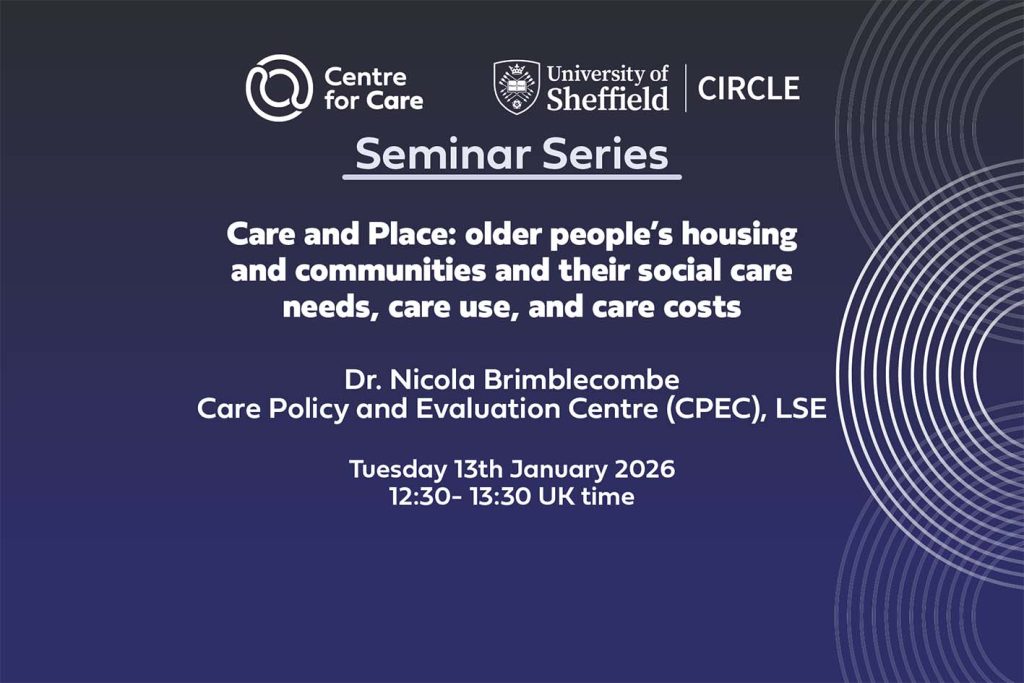
Seminar recording now available! We welcomed Dr. Nicola Brimblecombe to present ‘Care and Place: older people’s housing and communities and their social care needs, care use, and care costs’ on Tuesday 13th January 2026.
Read More about Seminar: Care and Place: older people’s housing and communities and their social care needs, care use, and care costs
Recent Publications
A selection of recent publications from the Care Trajectories and Constraints team.
Members
The Care Trajectories and Constraints team is led by Professor Majella Kilkey at the University of Sheffield.