Carer’s Allowance: Understanding complexity and inflexibility
This project builds on research underway at the Centre for Care exploring the risks to the financial wellbeing of unpaid carers. This found that very often, unpaid carers find the welfare benefits system confusing and overwhelming to navigate; some describe ‘perverse incentives’ and the complex interactions between benefits as barriers to claiming their entitlements, with some being deterred from claiming at all. In order to investigate this further, we interviewed welfare rights advisers based in organisations which support carers to access the benefits system across England and Wales.
This additional data complemented that collected through interviews with unpaid carers themselves, who often struggle to find their way through such a complex system. Indeed, many of the welfare rights advisers we interviewed said that without the practical and emotional support offered by advice services, many carers would simply give up, losing out on valuable income they are entitled to.
The project’s aims are:
- To understand how the complexity and inflexibility of the social security system affects unpaid carers’ ability to claim Carer’s Allowance, including how this affects decisions about employment and how it interacts with other benefits entitlements.
- To understand how practitioners employed by welfare support and advocacy organisations experience complexity and inflexibility when supporting unpaid carers to navigate the system and make decisions.
- To gather insights which could inform the simplification of benefits rules and systems and improve the experiences of unpaid carers in navigating the system.
The UK social security benefits system has been characterised in previous research as “a very complex system of interrelated, rule-based social security benefits… which are highly conditional and targeted” (Harris, 2006: 145). Complexity can arise when policy-makers incorporate new rules which try to more adequately reflect the ‘messiness’ of people’s lives (Bradshaw, 1985). However, from the perspective of people seeking support, the benefits system often appears designed to be intentionally complex as a way of reducing access (Saffer et al., 2018). Regardless of the origins of the complex interplay of rules and entitlements, “[u]nderstanding complexity is essential before we can work out where some simplification might be possible” (Spicker, 2006: 7). We will examine the extent to which complexity can fully explain the challenges experienced by carers in navigating the social security system.
Quotes from welfare rights advisers who participated in our research:
“And it says something about a system where something is so complex that actually people are happy to rely on an allegedly expert advisor because that’s the easy option … There are some things that are fundamentally wrong if you need to rely on an advisor just to even explain what it is you’re going for and to help fill in the claim pack.” Alan, welfare rights manager in a local authority
“You know, sometimes people effectively choose to make themselves worse off, just because it’s what they can manage at that period of time, really. It’s very simple for us, benefits caseworkers, to be like, “Yeah, financially, this is the way to go,” but we’re not necessarily in their shoes, thinking about all they have to manage on top of claiming benefits.” Jeremy, welfare rights adviser to people with a progressive condition and their carers / families
“The ones that strike me the most are those people that have been in pretty well-paid jobs, and then through circumstances, have to give up these jobs, sometimes without checking, and I know this sounds crazy, how much they’ll be entitled to if they give up the job. And then, the harsh reality of, “How much?” they say, or words to that effect.. they cannot believe how people can survive on such a low level of income, and then have to jump through hoops to get it.” Frank, welfare rights adviser based in a local carers centre
References
Bradshaw, J. (1985) ‘A defence of social security’, in Bean, P., Ferris, J. and Whynes, D. K. (1985) In Defence of Welfare. London: Tavistock.
Harris, N. (2006) ‘Complexity, Law and Social Security in the United Kingdom’, European Journal of Social Security, 8(2), pp. 145–178. doi: 10.1177/138826270600800203.
Saffer, J., Nolte, L. and Duffy, S. (2018) ‘Living on a knife edge: the responses of people with physical health conditions to changes in disability benefits’, Disability & Society, 33(10), pp. 1555–1578. doi: 10.1080/09687599.2018.1514292.
Spicker, P. (2005) ‘Five types of complexity’, The Journal of Poverty and Social Justice : Research, Policy, Practice, 13(1), pp. 5–9. doi: 10.51952/VQIE3724.
Related commentaries
Commentary pieces relating to Carer’s Allowance: Understanding complexity and inflexibility

Our research on unpaid carers is part of a nation-wide campaign!
Read More about Our research is featured by our funders in nation-wide campaign
We are very pleased to launch our new impact report today, ‘Towards a better future for care’.
Read More about Towards a better future for care: Centre for Care Impact report (November 2021-April 2025)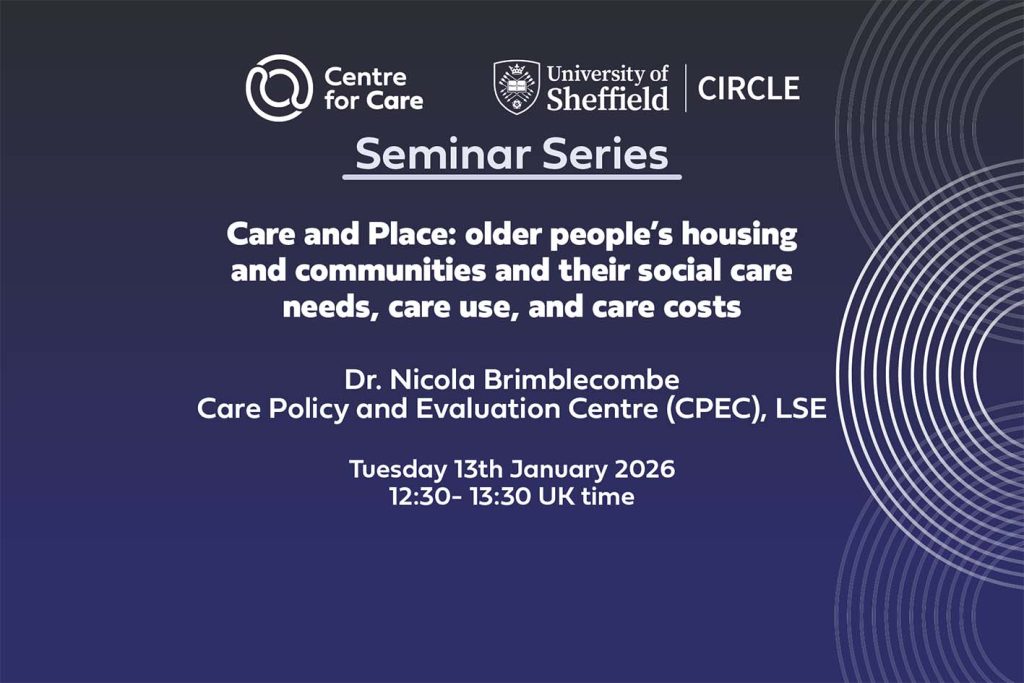
Seminar recording now available! We welcomed Dr. Nicola Brimblecombe to present ‘Care and Place: older people’s housing and communities and their social care needs, care use, and care costs’ on Tuesday 13th January 2026.
Read More about Seminar: Care and Place: older people’s housing and communities and their social care needs, care use, and care costs
Dr. Maxine Watkins and Dr. Louise Overton report on the first study to apply subjective notions of financial wellbeing directly to the experience of care and caring and with an emphasis on capturing and understanding changes in carers’ financial lives over time.
Read More about The life course costs of caring: Understanding unpaid carers’ financial wellbeing over time
Recent Publications
A selection of recent publications from the Carer’s Allowance: Understanding complexity and inflexibility team.
Members
The Inequalities in Care team is led by Professor Matt Bennett at the University of Sheffield.