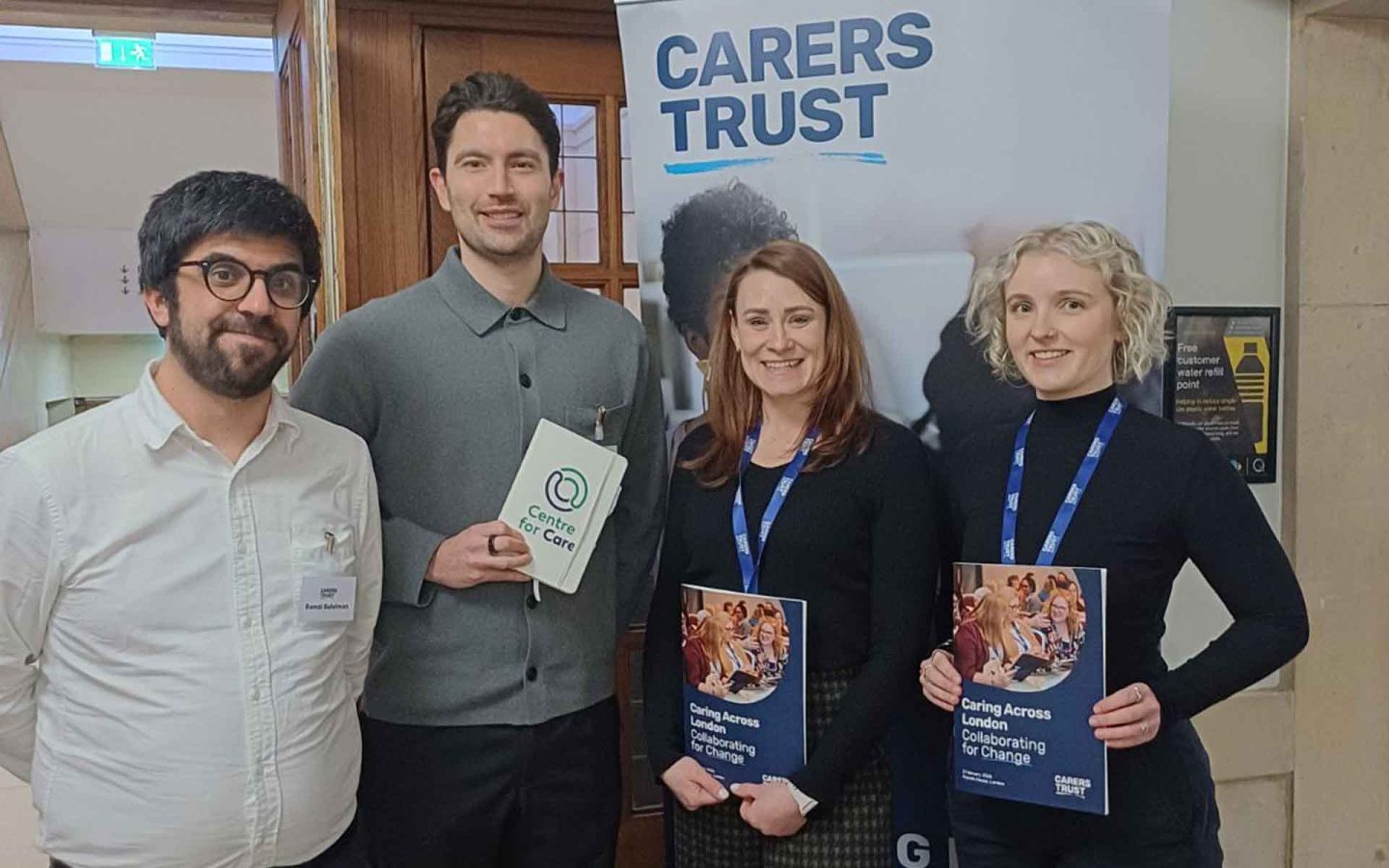
On 3rd February the Centre for Care impact team, Fay Benskin and Lucy Wood, attended a Carer’s Trust all day event – Caring Across London: Collaborating for change.
In light of the recent call for evidence from the London Assembly Economy, Culture and Skills Committee into the experiences of unpaid carers in London, this was an important convening of organisations who support carers in London and carers themselves, to understand more deeply the prevalent issues for carers in London and what different boroughs are doing to address them.
Identifying the needs of carers in London
The day opened with a welcome from Kirsty McHugh, the Chief Executive Officer (CEO) of Carer’s Trust who highlighted the importance of interrogating the care needs of Londoners as a diverse population. She hosted a discussion with Mike Rich, CEO of Barnet Carers and David Walker, CEO of Bromley Well (a network partner of Carers Trust). In Bromley, David noted the amount of carers is increasing and they are more likely to be in poverty.
Evidence suggests that unpaid carers often experience a financial cost to caring, which over the course of their lives, impacts their financial wellbeing. This is further compounded by existing financial disadvantages in a carer’s life, such as low paid insecure employment, unaffordable housing or repeated caring responsibilities in early and middle adulthood. Additionally, carers can experience an income penalty as a result of caring, which is worsened relative to the intensity and length of time care is provided.
The panel also noted that there are some specific demographic trends in London carers that require attention. Kirsty noted that there is a higher prevalence of young carers, ethnically diverse carers and carers registered with a disability. The Centre for Care has developed a tool by which these demographic characteristics can be mapped across all London boroughs. The Unpaid Care Dashboard uses Census data from 2011 and 2021 to report on the prevalence and intensity of care of unpaid care nationally and by local authority. It profiles carers’ health, disability, labour market participation, education and demographic characteristics and enables comparison over time and across geographies. The Unpaid Care Dashboard can be used to examine trends across London boroughs, which we drew attention to in our submission to the London Assembly’s call for evidence on the experiences of unpaid carers in London.
Language around care – how narrative matters
The next panel discussed shifting the narrative on carers, examining where there are opportunities for change. The panel was composed of: Yolande Burgess, strategy director for London Councils, Alice Dias, CEO of Carers’ Hub Lambeth and Dr. Usman Khan, Director of improvement, transformation and partnerships at NHS England, London region.
The panel discussed language in relation to carers, in light of the Carers Trust recent report on public narratives around unpaid care. They highlighted that public narrative around being a carer as a ‘victim’ or a ‘hero’ can create an ‘othering’ effect for carers. The impact of this can be that identifying carers is more challenging, as people may be less inclined to view themselves as carers within these narratives, but would find more resonance in discussions around the act of caring. This is particularly relevant as most people will come into contact with caring at some point in their life, be it as a carer or in receipt of care.
Identification of carers
Events across the day highlighted the need for better identification of carers, especially where young carers may not be adequately identified in schools.
A morning workshop included work from Eleanor Cross of Barnet Carers, and Richard Chester RGN of Royal Free London NHS Foundation Trust to improve the identification of carers in medical settings. Eleanor discussed a project with the North Central London (NCL) Health and Care Integrated Care System. They aimed to improve the identification of carers in hospitals through improved awareness for medical professionals, and create an easy referral system into localised care services. The NCL Carers Support project covers Barnet, Camden, Enfield, Haringey and Islington. This means that hospitals across these boroughs are covered by the project, with Eleanor and her team working with Richard to disseminate awareness about caring through training for staff, information about identifying carers on internal intranet pages, posters around the hospitals etc.
The Centre for Care’s call to action for a new National Carers Strategy echoes the need for better identification of carers. Centre for Care researcher, Chloe Alexander, also proposed a simple way to improve the identification of young carers by including a ‘don’t know’ option for young people being asked if they’re an unpaid carer in self completion forms across a range of services – schools, universities, GPs, social and housing services etc.
Co-production with caring communities – learning from best practice
Co-producing carers support services, sensitive to the needs of a diverse community and different population groups, was showcased in work across various boroughs in London.
Another morning workshop learned from Joanna Brunt about the Hackney Parent Carer Forum. Joanna shared learning about their experience of establishing a Parent Carer Forum and explained the main challenges and approaches to overcome them.
Young adult carers shared their experience of caring and being involved in influencing the way that carers support services are delivered. This demonstrated good practice and the benefit of co-producing services with young adult carers. Young adult carers spoke with passion and enthusiasm for the support they have accessed, including the benefit of building trusted relationships with staff and consistency of support.
Anna Campbell, service manager and Shereen, a carer, from Camden Carers discussed their project to build better connections and support with the Bengali, Somali and Chinese communities, called ‘making carers count’ – a Carers Trust initiative. Camden Carers worked closely with carers in these communities to develop culturally appropriate support from the carers centre. Alice Diaz, CEO of Lambeth carers shared the carers centre’s work to improve engagement with the local communities and improve their network of support with better ties to community organisations. Research at the Centre for Care echoes the need for ‘culturally appropriate support for carers’ that reflects the needs of diverse communities, which is particularly relevant for London as an ethnically diverse population.
Frameworks and standards for care – holding organisations to account
Additional to co-producing carers services with the communities affected, is holding organisations to account for the provision of care provided, particularly amongst racially minoritised groups.
Dr Jacqui Byer MBE (National Mental Health Equalities Advisor, NHS England) and Anastasia Blake (Chair of the Triangle of Care and Patient and Carer Race Equality Framework (PCREF) Group) talked about Jacqui’s Patient and Carer Race Equality Framework, the first anti-racist framework in NHS England. As of 2025, this framework is mandatory for all publicly funded mental health providers. The framework encourages improvement for organisations through: a commitment from leadership to prioritise the needs of racialised carers, to commit to data collection on race equality, to adhere to 6 co-produced organisational competencies and to incorporate carer feedback into their service development.
The day concluded with Kirsty asking the attendees what Carers Trust could do to better support carers in London. It was clear that attendees appreciated the bespoke forum to discuss the particular concerns of London carers and wanted to encourage continued engagement with; what effective co-production looks like, how to support young carers and carers across diverse population groups and to encourage different carers centres across the boroughs to engage with local community organisations.
This event was an excellent opportunity to learn from practitioners and unpaid carers. We learned about good practice and techniques to ensure that support is fit for purpose. It was also a wonderful opportunity to network with others working in the sector and share the work of the Centre for Care and explore how we can work together to support positive change.
About the author

Lucy is an Impact Associate in the Centre for Care, working closely with Fay Benskin and academics to improve the impact of research in decision making processes for key stakeholders across government policy and third sector organisations.