
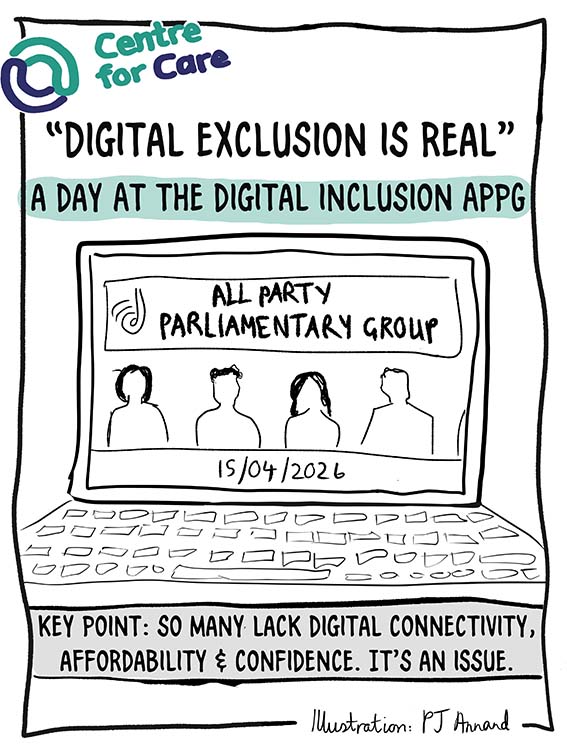
Last week’s All Party Parliamentary Group (APPG) event on ‘Digital Inclusion and Healthcare’ was a rich, informative and, in many respects, usefully critical discussion. It brought together a set of concerns that are too often treated separately, or encountered only as implementation problems after key political decisions have already been made. Speakers returned, repeatedly and productively, to questions of affordability, access, skills, community support, proxy use, and the labour of those who are now being named as ‘digital carers’ – or what Centre for Care research has described as ‘machine babysitters’ (Hamblin, 2022). These are not unfamiliar issues, but what was special was that panellists refused the complacent assumption that rising uptake of digital services is the same thing as substantive inclusion. There was a distinct, and welcome, feeling that everyone took seriously the conditions under which digital transformation in health and care either becomes publicly meaningful or simply redistributes burden elsewhere.
Inclusion on what terms?
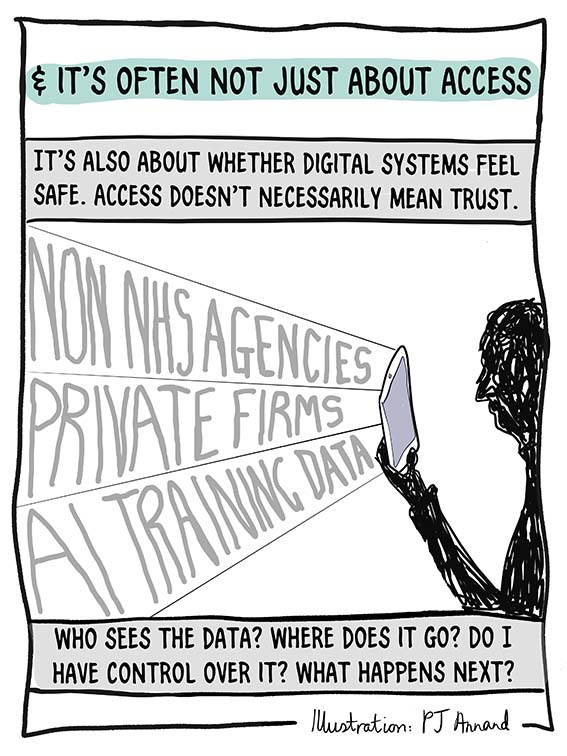
At the same time (and very much in the spirit of extending rather than correcting the discussion) there is one issue that still deserves some sustained attention of its own. For some people, the problem is not only that digital systems are difficult to use, expensive to access, or unevenly supported. It is also that the present arrangements of data sharing, data extraction and institutional visibility can feel unsafe, opaque and beyond their control. This is not to suggest that questions of digital connectivity, affordability or confidence are somehow overstated (they are decisively not), nor is it to imply that reluctance about data is the hidden truth behind all forms of digital exclusion. Rather, the point is that ‘digital inclusion’ can easily be framed as though the main task were bringing people into digital systems that are already given, when for some people the prior question is on what terms those systems are to be entered at all. Here at Centre for Care our work highlights that participation in digital systems is also participation in regimes of data collection, circulation and use, and that those regimes are not experienced as neutral by all publics (Whitfield, 2023).
The importance of that distinction lies in the fact that inclusion on those terms is not necessarily inclusion on just terms. A person may have the device, the connectivity and even the confidence to use an app, and still have good reason to hesitate if they do not know where their data will go, who will be able to see it, how it may be linked across services, or whether it may later be used in ways they neither expected nor meaningfully consented to. This does not mean that data sharing is always inappropriate, nor that digital systems are inherently suspect – and equally, it would be too simple to conclude that mistrust is merely a matter of misunderstanding that could be resolved through better communication alone. What becomes clear though is that ‘digital inclusion’ should not be reduced to interface design, training or connectivity, however important those remain. It must also include the legal and governance conditions that make participation safe enough, legible enough and controllable enough to be a real option rather than a compelled risk. Centre for Care has repeatedly pointed in this direction, not because the Centre rejects digital innovation as such, but because it places questions of trust, governance and responsibility alongside those of access and implementation (Centre for Care, 2026).
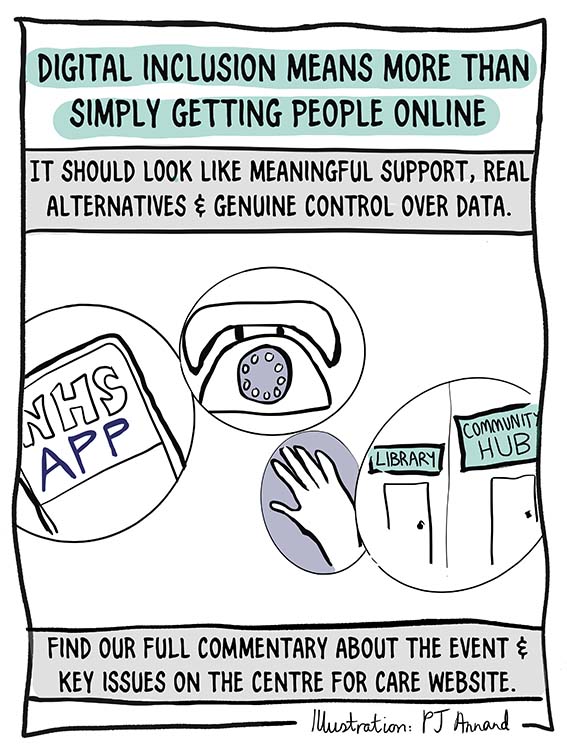
Seen in that light, the event’s emphasis on ‘choice’ and on alternatives to ‘digital by default’ can be extended rather than contradicted. Choice is not only about whether there is a telephone line, an in-person option, or a community worker able to help, but is also about whether people have meaningful say over the circulation and consequences of their data and can make decisions accordingly without compromising on the quality of their care and support. Where that control is weak, or where the governance framework is unclear, people may appear ‘hard to reach’ or ‘reluctant’, when in fact their caution may be an entirely reasonable response to institutional opacity. Some strands of Centre for Care research feel particularly relevant here, such as the ‘Digital Care Top 10’, for instance. This project is not valuable because it promises rapid closure, but because it begins from the premise that the central questions about digital technology in social care are not yet settled, and that a more adequate research agenda has to be informed by people with lived experience of care, caring and care work rather than built around assumptions already fixed in policy discourse (Centre for Care, 2026).
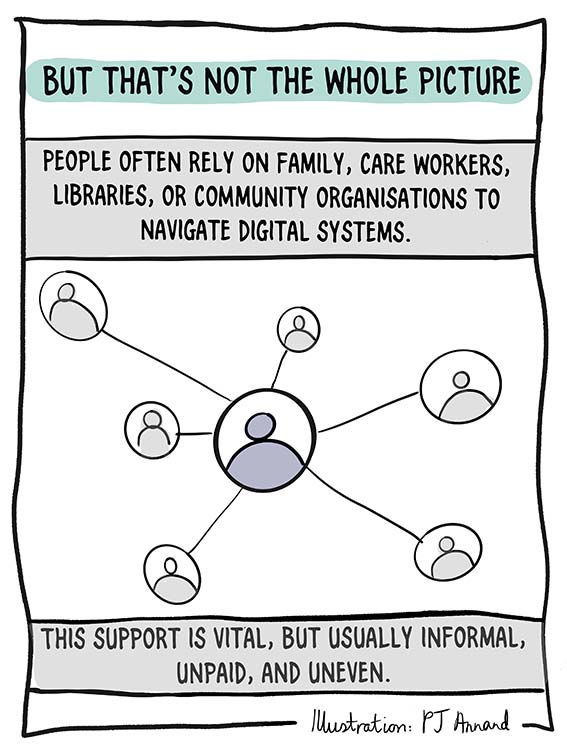
The event’s discussion of ‘digital carers’ went on to recognise ‘digital carers’ as a key role, and even as a form of essential infrastructure, was a politically significant message from the room – not because naming alone resolves anything, but because it begins to render visible a relation that policy has often preferred to leave diffuse. Centre for Care’s work on unpaid carers is especially helpful in this respect, because it moves from the appealing language of support and empowerment to a more careful account of what is being offloaded, and onto whom. Research on unpaid carers in South Yorkshire shows how digital exclusion intersects with low income, poor health and caring itself, while subsequent work on older unpaid carers indicates that policy languages of ‘choice’ and ‘control’ often rest upon non-digital alternatives and support infrastructures that are thin, inconsistent, or transferred into domestic and community labour (Hamblin and Black, 2023, pp. 8-12; Roussaki et al., 2024). In this way, the event’s appeal to ‘digital carers’ becomes especially analytically useful when it is read not simply as a new role to be celebrated, but as evidence that health and care systems are already leaning on informal infrastructures whose costs they do not fully ‘count’.
Something similar can be said about the event’s enthusiasm for ‘digital leads’ and ‘digital champions’ and, indeed, counterparts in particular domains of health and care (for example ‘digital midwives’). These may be important developments, and practice-based work certainly suggests that local partnership models can improve access to devices, data and confidence. At the same time, the existence of such roles also tells us that access to supposedly universal services increasingly depends on intermediaries who translate, reassure, troubleshoot and/or repair. This is not an argument against such roles, but gives rise to a slightly different question – namely, why increasingly complex public systems require so many brokers simply to remain navigable, and what it means when inclusion is delivered through local ingenuity rather than guaranteed through institutional design. Centre for Care’s research situates these developments within a wider policy landscape in which innovation is advanced through procurement, pilots and implementation discourse, while the labour of adaptation is often carried elsewhere (Whitfield and Hamblin, 2022, pp. 5-9).
Data gaps
This wider framing also helps with another set of issues raised at the event around data gaps, as well as points made on social risk assessments, alongside the currently widely-discussed topic in Parliament about automatic translation tools for people less able to use English when interacting with health and care services. There was, understandably, a broad concern in the room that better data are needed on minoritised groups, on digitally excluded populations, and on people whose social circumstances affect access to care. Better visibility may support better service design; equally, data collection can deepen mistrust where people have good reason to question who benefits from the extraction, circulation and commercial use of care data (Whitfield, 2023). In a related way, the discussion of tools such as Google Translate helpfully signalled that ‘inclusion’ cannot be reduced to simple availability. NHS England’s framework on community language translation and interpreting services underscores the need for consistent, high-quality provision for people with limited English proficiency, which is another reminder that convenience and adequacy are not the same thing, and that some forms of digital mediation can intensify risk under the sign of accessibility (NHS England, 2025).
It is in this respect that another strand of Centre for Care’s work emerges as useful. The South Yorkshire ‘Digital Poverty’ heatmap does not simply identify where connectivity is weaker, but overlays connectivity with indicators of poor health, deprivation and unpaid care, making it harder to imagine ‘digital poverty’ as merely an individual deficit or a narrow technical problem. Likewise, the Unpaid Care Dashboard goes beyond just visualising census data, and makes caring populations and patterns of unpaid care more legible to policymakers and practitioners, while also showing that unpaid care, health, place and inequality are deeply entangled rather than administratively separate (Centre for Care, 2025a; Centre for Care, 2025b). These tools do not settle the conceptual issues, but do help keep the analytical frame open in the right way, by showing that ‘digital inclusion’ is not a standalone domain but one point of intersection between care, infrastructure, poverty and public service design.
What follows from all this is the key message that, if ‘digital inclusion’ is to be taken seriously then it must mean more than helping people enter digital systems on terms set elsewhere. It must also mean creating the legal, institutional and governance conditions under which people can use those systems without fearing that their data will go where they do not want it to go, be seen by actors they did not expect, or produce consequences that impinge on their autonomy, privacy or basic rights. The APPG discussion was absolutely right to foreground devices, affordability, skills, champions, carers and alternatives. Future discussions of inclusion will ideally also add that people do not only need support to use digital systems, they also need reasons to trust them, and structures of control robust enough to make that trust warranted. Centre for Care’s voice is especially valuable here, precisely because it resists the false neatness of the problem itself, keeping in view labour, data politics, unpaid support, institutional responsibility and infrastructural inequality at the same time.
References
Centre for Care (2025a) Unpaid Care Dashboard. Available at: https://centreforcare.ac.uk/uuc-dashboard/.
Centre for Care (2025b) Bridging data gaps. Available at: https://centreforcare.ac.uk/how-we-work/bridging-data-gaps/.
Centre for Care (2026) Digital Care and Innovation. Available at: https://centreforcare.ac.uk/topics/digital-care/.
Hamblin, K.A. (2021) ‘Technology in care systems: Displacing, reshaping, reinstating or degrading roles?’, New Technology, Work and Employment, 36(2), pp. 1–18. Available at: https://doi.org/10.1111/ntwe.12229.
Hamblin, K. and Black, R. (2023) Digital exclusion and unpaid carers in South Yorkshire. Sheffield: Centre for Care, pp. 8–12. Available at: https://centreforcare.ac.uk/wp-content/uploads/2023/05/Digital-exclusion-and-unpaid-carers-in-South-Yorkshire-1.pdf.
NHS England (2025) Improvement framework: community language translation and interpreting services. Available at: https://www.england.nhs.uk/publication/improvement-framework-community-language-translation-interpreting-services/.
Roussaki, A., Zamani, E., Sbaffi, L., Hamblin, K. and Black, R. (2024) ‘The digitalisation of social care in England and the implications for older unpaid carers: a constructionist thematic analysis’, Journal of Medical Internet Research, 26, e60056. Available at: https://www.jmir.org/2024/1/e60056.
Whitfield, G. (2023) ‘Who cares about data? Tensions between public trust and private interests in health and social care’, Centre for Care Commentary, 19 December. Available at: https://centreforcare.ac.uk/commentary/2023/12/public-trust-and-private-interests-in-health-and-social-care/.
Whitfield, G. and Hamblin, K. (2022) Technology in social care: spotlight on the English policy landscape, 2019–2022. Working Paper 1. Sheffield: Centre for Care, pp. 5–9. Available at: https://centreforcare.ac.uk/wp-content/uploads/2022/12/Technology-in-social-care-report-Dec-2022_FINAL.pdf.
PJ’s illustrations
About the author

Dr PJ Annand is a researcher, illustrator and activist, leading the Digital Care and Innovation research theme, and the Digital Care Top 10 and Innovations in Queer Care projects at the Centre for Care.