It’s Carers Week 2026 and this year the theme is “Building Carer-Friendly Communities”. The Centre for Care is studying unpaid carers, and care more broadly, in different community settings so we have put together a roundup of some of our community-focused research, and opportunities to get involved in improving support for carers in the UK.
The role of good data in building carer-friendly communities
In 2025 we launched our Unpaid Care Dashboard, which uses Census data to bring you key statistics about carers in over 300 Local Authority areas in England and Wales.The dashboard can be used to improve general understandings of patterns of care, learn how resources or services might be changed to support local populations, and to help support the development of business cases.
This week we have added a new function to the Unpaid Care Dashboard webpage- we have drafted downloadable council motions detailing key statistics in every Local Authority in England and Wales. This means council members can easily advocate for a better strategy for supporting unpaid carers in their area. Are you in touch with your local council members? Let them know about this easily accessible data!
Members of our team are travelling this week to talk about our research, and here are some statistics for those areas:
On Monday our Director Professor Kate Hamblin will be in London at an event held by Carers UK and TSB with Ministers, exploring balancing paid employment and unpaid care.
In the City of London, the Dashboard shows:
- There are 14,000 unpaid carers. Of these unpaid carers 40% are not in work, and 19% themselves are registered as disabled.
- If the care provided by unpaid carers had to be replaced with paid care services, the Centre for Care estimates that in 2021 this would have cost this Local Authority £439m.
- Since the 2011 census the value of unpaid carers in the City of London has increased by 25%.
On Tuesday Kate will be speaking for our funder’s (UKRI) Staff Carers Network. Kate will be sharing insights from our research on unpaid carers, the inequalities they experience and the challenges they face around combining work and care, reflecting on work to shape policy and practice to enhance the lives of carers.
Our Impact Associate Lucy Wood will be at the Walsall Carers Hub, at a carer information day hosted by Forward Carers. Lucy will be representing the Centre with a stall, showcasing our research and impact work advocating for better support for unpaid carers.
In Walsall, the dashboard shows:
- There are 26,413 unpaid carers. Of these unpaid carers, 52% are not in work, and 29% themselves are registered as disabled.
- If the care provided by unpaid carers had to be replaced with paid care services, the Centre for Care estimates that in 2021 this would have cost the Local Authority £968m.
- Since the 2011 census the value of unpaid carers in Walsall has increased by 27%
On Wednesday our Impact and Communications team will be showcasing our giant board game, ‘Mind the Gap: Tackling Inequalities for Unpaid Carers’, in Derbyshire at a celebration of unpaid carers event hosted by Derbyshire Community Health Services.
In Derbyshire, the dashboard shows:
- There are 73,320 unpaid carers
- 61% of those carers are female
- 76% of the carers identified are economically active (in paid employment) and would most likely benefit from support from their employer to manage work and care.
Visit the Unpaid Care Dashboard page to learn about caring in your area. It could help you and your organisation build a more carer-friendly community. Let us know how you use it!
Contact us here: https://centreforcare.ac.uk/about/contact/
Considering the Care Ecosystem
Viewing social care as an ecosystem means recognising it is a complex, adaptive system, featuring ‘emergent’ outcomes (that are hard to control, but not random) and ‘episodic’ changes (responses to past events, internal ‘feedback loops’ and external ‘shocks’ that may lead to tipping points and change).
In our Care Ecosystem research theme, when looking at UK local and national systems we look at market stability, user outcomes, access to information and support, and workforce retention, and ask, ‘Can we identify common system features that enable ‘best fit’ to support sustainability, equity and wellbeing?’
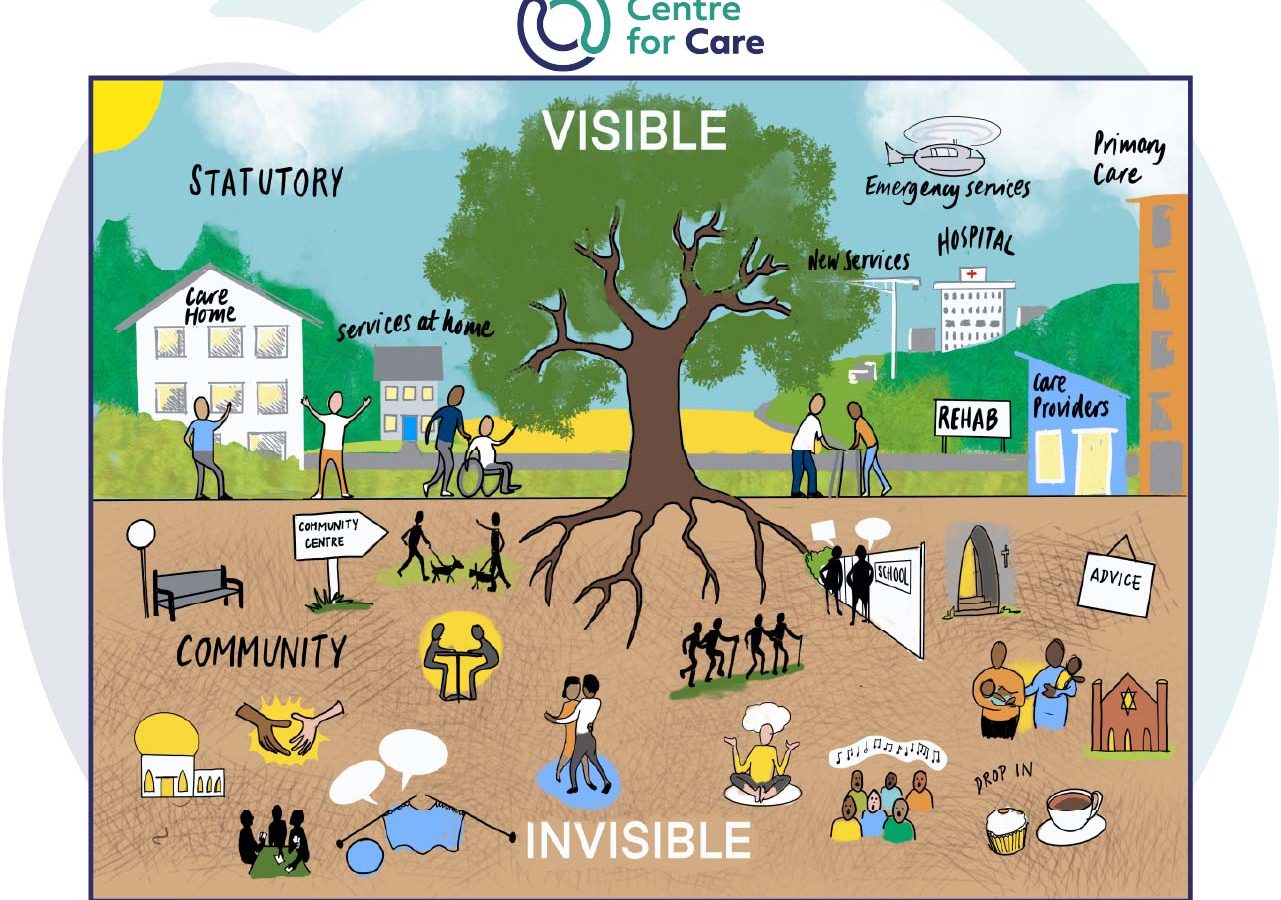
Here we show our visual representation of a flourishing social care ecosystem, drawn by the artist Laura Brodrick (Home – Think Big Picture). It’s developed from the idea that a flourishing system has activity both above the soil line (visible) and below the soil line (invisible).

Things like care homes and hospitals are the visible part of the system – a bit like the mammals and birds that we see in nature. The invisible parts are all the small community activities which aren’t necessarily thought of as part of social care but are like the microorganisms that make the soil rich and fertile. These are the coffee mornings, choirs, sports clubs, dance groups, faith organisations, and family and neighbourhood networks that help people to have purpose and meaning.
In our research in the Centre for Care we are looking at what characteristics of local social care ecosystems lead to flourishing. We explore whether the features of some local systems make them more likely to be degraded and failing, and how we can support flourishing everywhere.
Get an update on what we have learned so far in our research on the Care Ecosystem by listening to this episode of the Care Matters podcast featuring our research team, Professor Catherine Needham and Dr Emily Burn: https://www.podbean.com/ep/pb-74hyi-19df623
Visit our Care Ecosystem webpage here to find research reports, links to academic articles and book chapters: https://centreforcare.ac.uk/topics/care-as-a-complex-adaptive-ecosystem/
Young adult carers
Young people in the UK are frequently involved in caring for family members. They might continue to be involved in care, which started in childhood, or it might start for the first time in young adulthood. Young people care for family members or friends in a wide range of circumstances. Some get labelled as young adult carers and this can be a gateway to services and support.
A group of young adult carers took part in discussions about how it feels to connect with services and the reasons that young people might distance themselves from sources of support. Identifying as a young adult carer, both in terms of your sense of yourself and in terms of the labels that come from support services, is complex and fluctuates for each individual.
When a young person is asked whether they might be a carer the options they have for responding tend to be “yes” or “no”. In the experience of this group it is very common to feel like they “don’t know” if they fit that description. A “don’t know” option when asking if someone is a carer could open up discussions for more young people to find out what being a carer means, whether it applies to them and what happens if they connect with support. Through a “don’t know” option, services can recognise the complexity when young people to identify themselves as a carer and support them through a process of identification.
Read more about this in ‘Young adult carers and the ‘don’t know’ option‘- a research briefing by Dr Chloe Alexander.
Carer-friendly workplaces
Every single day in the UK, 5,300 people in paid employment become unpaid carers. Balancing work and care can be an immense challenge, often leading valuable staff to leave the workforce early.
Last week we announced a series of training sessions aiming to improve support for unpaid carers in workplace communities in Sheffield, ‘Sheffield Carers about Carers’.
We are delighted to invite you to these sessions delivered alongside Sandwich Generation Support to improve Sheffield employers’ understanding of the challenges faced by employees with caring responsibilities.
The training will support employers to:
- Improve their understanding of the emotional and practical impact of balancing work and caring.
- Identify clear, practical steps to support carers in their teams and the wider organisation.
- Create a supportive and understanding workplace culture.
- Promote workplace support for working carers including carer passports, supportive management and carers networks.
- Have confidence in applying policies and using workplace flexibility
The training would be suitable for CEOs, line managers, team leaders, EDI leads and representatives, or HR professionals.
Please note that these sessions are in-person events held at the University of Sheffield.
Dates of the training:
- 1st July 9am to 12pm
- 6th July 9am to 12pm
- 15th July 9am to 12pm
Please register here to secure your place.
Care in Comics: Combining work and care
Last year we produced a comic which spotlights what good workplace support could look like, illustrating the benefits such support can bring to employees with caring roles outside of work and to their employers. We hope the ‘Sheffield Cares About Carers’ training sessions will help make a positive impact in Sheffield for people like Beth. Click here to read Beth’s story.
Racially minoritised communities
Older people are often talked ‘about’, rather than directly included in, conversations about care. Meanwhile, migration-related conversations often focus on younger migrants.
Our “Migration and The Right To Care” report, written by Dr Jayanthi Lingham and Professor Majella Kilkey, addresses this gap by foregrounding the voices of older migrants and understanding how their migration histories might affect current care experiences and needs, including their rights to equal access to good care.
Our overall findings from the report are:
- Care relationships and needs are global. Care relationships include globally separated families and communities, even when people have lived in the UK for decades.
- The importance of connected health and social care systems. Joined up health and social care systems are crucial, but other services, especially housing, also matter – without these, care needs increase.
- Migration histories and experiences shape care needs today. The UK’s hostile immigration system affects wellbeing significantly, increasing people’s health and care needs.
- Racism damages health and undermines care. Longstanding racism in institutions and systems harms the health and wellbeing of racially minoritised migrants in the UK, impacting their care needs in later life.
- Meanings of ‘good care’. Good care is multi-relational and involves much more than a two-way relationship between caregiver and care receiver.
- Economic marginalisation increases health and care needs. The cost-of-living crisis, economic inequalities, and immense financial costs of the immigration system, all affect older migrants’ wellbeing.
What needs to change?
We are advocating for the right to both receive and provide good care. Read our policy recommendations and the report here: https://centreforcare.ac.uk/publications/migration-and-the-right-to-care/
What does a “carer-friendly community” look like in a digital world?
As public services – including social care support – increasingly shift to online platforms, we often hear about the ‘transformative’ power of technology to make people’s lives easier. But Centre for Care research highlights a critical, often invisible barrier: a digital disconnect facing our unpaid carers.
While digital tools like online prescription ordering and video calls can save time, a blanket ‘digital by default’ approach is leaving many behind. Research from the Centre for Care and our University of Sheffield colleagues Laura Sbaffi, Anastasia Roussaki, Efpraxia Zamini, Sara Vannini, Sharon Wagg and Rachael Black highlights how unpaid carers are frequently feeling ‘pushed’ online without the necessary support, infrastructure or choice. Unpaid carers save the economy billions of pounds annually, yet they are routinely forced to navigate a fragmented digital landscape just to get basic support.
Research with carers in South Yorkshire and across England underscores how many carers face severe connectivity issues, living in ‘digital deserts’, or simply cannot afford the soaring costs of broadband and constantly updating hardware. Carers also face barriers in terms of the time required to set up, navigate, and troubleshooting confusing online portals and automated ‘chatbots’ contribute to the ‘time poverty’ they already face. Carers also voiced concerns about the impact of ‘digital by default’ in public services on in-person support, and how important it is in times of crisis, as well as raising issues of privacy and trust.
In November 2025, the Centre for Care launched a research briefing on the topic of digital exclusion and care at an event in the House of Commons where we brought the experiences of carers and people receiving support to life with our Mind the Gap: Tackling Digital Exclusion Board Game. In our briefing, we recommend the following collective actions between government, industry and civil society:
- Digital by choice, not default. There should be recognition that tackling digital exclusion is not just about building infrastructure or the skills of individuals. Some people choose not to be online (for reasons of preference, trust, etc.) and therefore maintaining ‘offline’ options in social care is crucial as without them, some of the people who are most in need of support will be excluded and disadvantaged.
- Partnership and place-based initiatives based on local need. It is essential to provide resources to trusted organisations who play a key role in supporting digital inclusion through long-term funding, to enable them to support local communities to become more digitally included.
- Practical, ongoing support to address issues of skills and confidence. Inclusive community spaces or ‘hubs’ are needed, with trained supporters to facilitate access to online resources and develop digital skills. Training should be user-friendly, jargon-free, and cost-effective and delivered in short, simple sessions.
- Actions to address issues of affordability and costs. The cost of purchasing, updating, repairing and replacing devices are key challenges for many people who access care and support, and their carers. Loan and repair services for devices, social tariffs and the National Data Bank to support people to connect online and publicity about these services are important measures to tackle digital exclusion
The causes of digital exclusion are wide-ranging; solutions need to be considered within the broader context of marginalisation and discrimination. Let’s champion a future where community support is defined by empathy and accessibility – not just an internet connection.
Follow us this week!
Keep an eye on our social channels this week and help us repost our crucial research findings and recommendations!
- Click here for our LinkedIn profile
- Click here for our Instagram profile
- Click here for our BlueSky profile