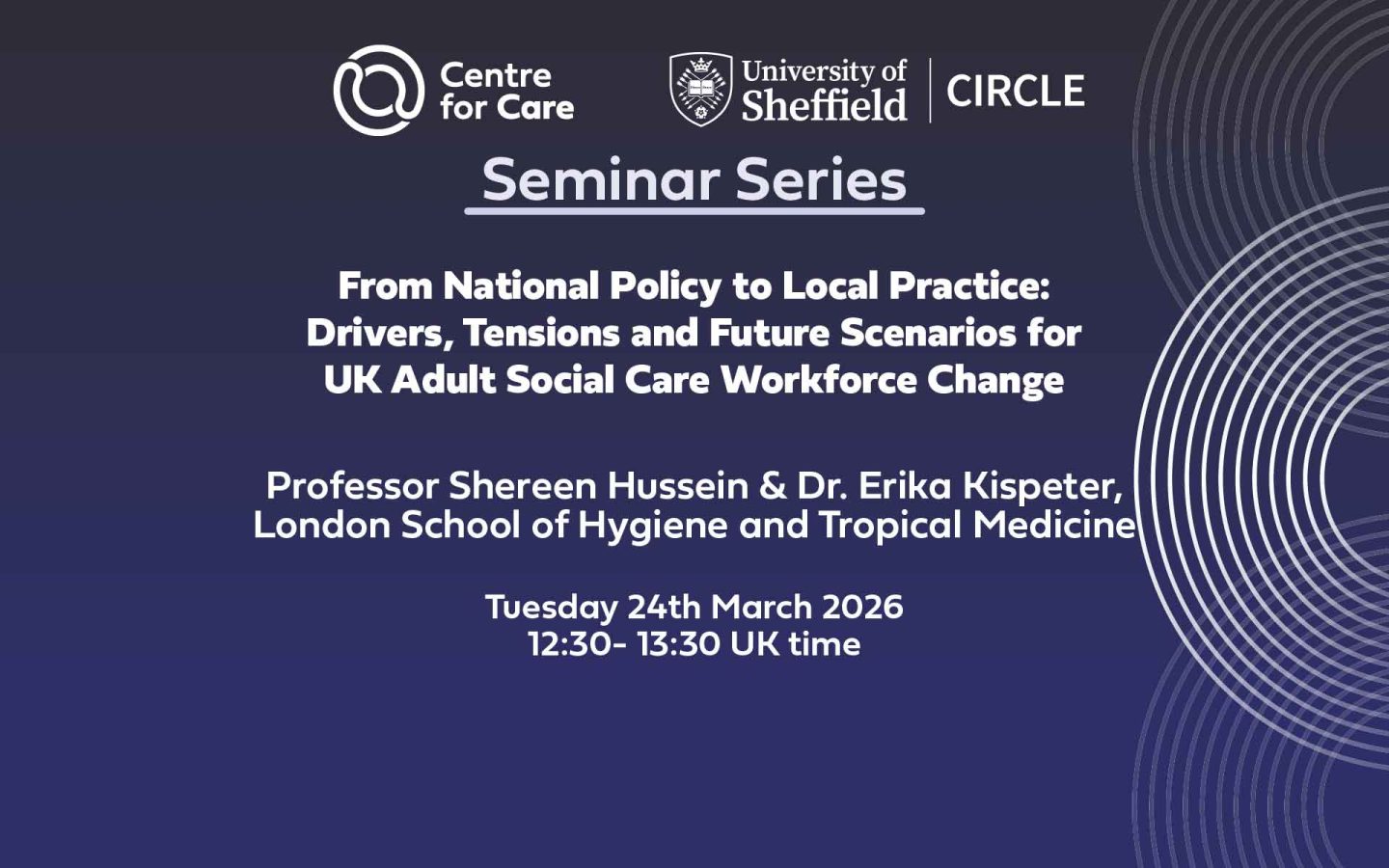
We are delighted to virtually welcome Professor Shereen Hussein and Dr. Erika Kispeter from the London School of Hygiene and Tropical Medicine to present ‘From National Policy to Local Practice: Drivers, Tensions and Future Scenarios for UK Adult Social Care Workforce Change‘ as part of our Seminar Series.
Date: 24th March 2026
Time: 12:30-13:30 UK time
Online event, please click here to register using a Google form.
Having trouble accessing this form? Please contact us via our website, or email centreforcare@sheffield.ac.uk.
About the seminar
This seminar shares insights from ‘Understanding the drivers and implications of care workforce change,’ exploring how policy and broader system factors are transforming the adult social care workforce throughout the UK. It starts with a review of academic and grey literature to identify key national social care policies and evaluate their expected and unforeseen impacts on the workforce across the four nations.
We then consult with adult social care stakeholders to validate and improve these findings. The initial research identified key policies influencing workforce change: professionalisation, health and social care integration, personalisation, digitalisation, funding reform, and migration policy. Although the evidence mainly highlights macro-level policies, stakeholders stressed that the most immediate drivers are often local, such as commissioning practices, including fee-setting, contracting models, and commissioner skills, and local market structures that impact job quality, pay, and retention. This feedback led to a revised list of priorities, emphasising commissioning and market dynamics alongside professionalisation, funding, integration, and migration.
In the final stage, we adopt a foresight approach to examine potential workforce futures by 2035, using stakeholder-developed scenarios. Two scenarios depict system transformation: one driven by sustained national investment and better terms aligned with NHS standards; the other by reforming commissioning and implementing outcomes-focused, person-centred models that optimise local resources. A third scenario explores the effects of legalised assisted dying on workforce roles, training, and well-being. We conclude by emphasising key policy synergies and conflicts, particularly among personalisation, professionalisation, and integration, and by considering the implications for workforce strategy, local authority capacity, and the design of reforms that are feasible locally and support person-centred care.
About the presenters
Shereen Hussein is Professor of Health and Social Care Policy at the London School of Hygiene & Tropical Medicine (LSHTM) and an internationally recognised thought leader in ageing, long-term care (LTC), and social policy. Trained as a medical demographer, she has built a distinguished career at the intersection of population science and social policy, shaping evidence-informed responses to the complex and evolving challenges of global ageing.
She is the founding Director of the C-Care: Centre for Care Research and Policy at LSHTM, a multidisciplinary hub advancing cutting-edge research on long-term care in the UK and internationally. C-Care promotes cross-sector collaboration and examines care systems within their wider social, economic, and political contexts, with a strong emphasis on equity, inclusion, and real-world impact. A committed mentor and advocate, Professor Hussein is deeply invested in developing the next generation of scholars and strengthening research capacity in the historically underfunded field of social care.
Professor Hussein has led or co-led more than 30 major research programmes, including several multi-million-pound studies funded by the NIHR, ESRC, and The Health Foundation. She is the lead of the ESRC Centre for Care Workforce Change Research Group. Her research spans a wide range of critical areas, including:
- the care workforce
- migration and care ethics
- elder abuse and safeguarding
- ageing in low- and middle-income countries
- the wellbeing of paid care workers and unpaid carers
- climate hazards and the sustainability of long-term care delivery
She is a trusted advisor to governments and international organisations, including the World Bank, WHO, UNICEF, and the United Nations. Her expertise has informed national ageing strategies and care frameworks across diverse contexts, from Europe and the Gulf region to Australia. In the UK, she has advised the House of Commons Health and Social Care Committee and the UKRI Healthy Ageing Challenge on key issues relating to ageing and the care workforce.
Erika Kispeter is a Research Fellow at the London School of Hygiene and Tropical Medicine. She is a member of the Care Workforce Research Group at the Centre for Care. The Group is conducting a programme of research focused on the social care workforce in the UK, exploring, among other topics, changes in how social care is organised and delivered, the terms and conditions of care workers’ employment and the impact of digital technologies on the paid work of care.
Erika’s main research interests are in the area of work and employment, with a particular focus on gender inequalities and skills. She has led and contributed to applied research projects that are relevant to both academia and public policy, for example, on digital skills, graduate careers and work-care ‘reconciliation’. Erika uses mixed methods in her research, ranging from qualitative interviews and participant observation to organisational case studies and large-scale surveys.
Prior to joining the LSHTM in 2022, Erika worked at the Institute for Employment Research at the University of Warwick and at the Centre for International Research on Care, Labour and Equalities (CIRCLE) at the University of Leeds.
Please click here to register using a Google form.
Having trouble accessing this form? Please contact us via our website, or email centreforcare@sheffield.ac.uk.
The Centre for International Research on Care, Labour and Equalities (CIRCLE) and Centre for Care Seminar Series
In this seminar series we invite colleagues, partners and experts, whose work aligns with the mission of our Centre, to share their work with us and our audiences, to deepen our understanding of the critical issues in social care in the UK and around the world.
Click here to view more upcoming events and past event recordings.