During my time at Sheffield, I have aimed to make the most of the varied opportunities that doctoral study can offer, and particularly the chance to learn about new places and unfamiliar research fields. Hence I was thrilled to get the opportunity – thanks to the Centre for Care’s Capacity Building Fund – to spend four weeks on a recent academic visit to Australia. Building on a range of networks, including the Centre for Care’s International Partners in Australia, I travelled to Perth, Melbourne, Canberra and Sydney, presented my research at four universities, and made innumerable new connections with researchers across a range of career stages. Outside of meetings and presentations, I also spent time engaging with cultural life in Australia, visiting museums, libraries, and historical sites.
My PhD examines the experiences of men working in the Adult Social Care sector in England, and hence sits at the intersection of several different research fields, including scholarship on care, men and masculinities, migration and race, and employment and work. In Australia I was able to connect with experienced researchers across these fields, providing me with a range of new conceptual and empirical insights. Below, I provide a short summary of what I did on the visit and how what I learnt is impacting my thesis.
Perth
Having landed in Perth a little disorientated, I was fortunate to connect with Professor Loretta Baldassar, Dr Cat Stevens, and other team members at Edith Cowan University (ECU). Loretta leads the Migration, Diversity and Care Research Programme, which includes the ECU Social Aging (SAGE) Futures Lab and TRACS Diversity Research Network (DRN). I presented to the DRN group and led a PhD workshop on the subject of ‘imposter’ research participants (Merchant, Atherton and García-Iglesias, 2025). Along with the SAGE team I also attended the Positive Ageing Summit – a day of interdisciplinary talks which encouraged me to think more deeply about the socio-cultural components of ageing and how ‘successful ageing’ is defined in the UK. Across the 10 days I spent at ECU, I had many other fruitful conversations with colleagues, particularly surrounding my first empirical chapter (which draws on theories of Racial Capitalism), and these discussions encouraged me to think in more historical terms about the relationships between migration, racialisation and care work.
While in Perth I also met and presented to members of the Social Sciences Department at Curtin University. The helpful comments and questions I received during this presentation led me to arrange further meetings with members of the department, including Dr Cathy Martin, co-convenor of the ‘Sociology out West’ group, and chief investigator for a co-designed project examining the connection between environmental volunteering and positive ageing. We spoke about Cathy’s PhD work, which focused on the use of metaphors to frame immigration in the Australian press, and migration policy in the UK and Australia; a timely issue for the Adult Social Care sector (see this article by Centre for Care colleagues for more information). I also had a very useful follow-up meeting with Dr Vannessa Hearman, Senior Lecturer in History at Curtin, in which we discussed historical sociology and life history approaches to researching care, which I intend to draw on in future research projects.
Melbourne
Next, I flew to Melbourne, where I met with Professor Steve Roberts at Monash University. Steve has recently been the Primary Chief Investigator for the Addressing the deficit in men’s participation in paid care work project, which has clear parallels with my own work. We had lots of talk about, including methodological issues, shared and divergent empirical findings, and upcoming publications that Steve and his colleagues have been working on. We also discussed the concept of ‘caring masculinities’ (originated by his colleague, Karla Elliot (2016)) and how the concept might (or might not) apply to our various research findings. This conversation encouraged me to think more deeply about whether my findings really fit with this area of theory, or if other concepts might be more relevant to my work.
Canberra
After Melbourne, I travelled to Australia’s capital, Canberra, where I was based for three days. While there I met with Dr Matt Withers and presented to members of the School of Sociology at Australia National University. I received some very helpful feedback from members of the department about how to approach the men and masculinities literature I was drawing on, and had further conversations with Matt and PhD students about a number of issues, including dementia and end of life care in Australia, migration policy, and qualitative research methods.
Sydney
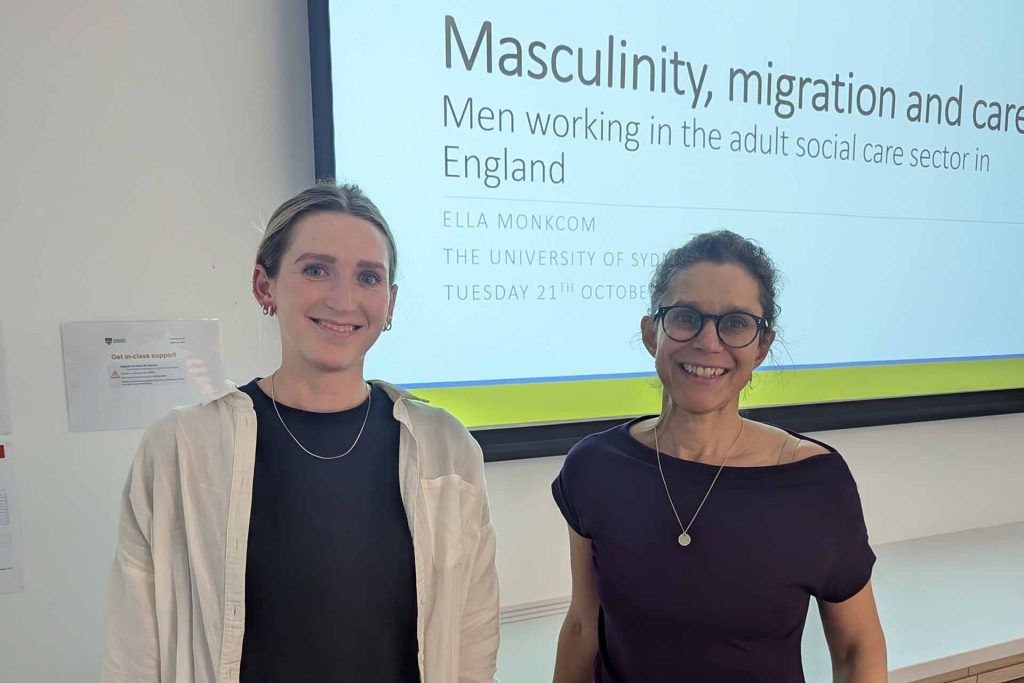
My final stop was the University of Sydney. I met Dr Leah Williams Veazey, who is currently undertaking an early career research fellowship examining the intersections of work, migration and care in the lives of healthcare workers. I had several long conversations with Leah, particularly around methodology and thesis writing, as well as broader discussions about how to navigate working life as an early career scholar. On the 21st October, I also presented my work to members of Sydney Centre for Healthy Societies and The Australian Centre for Gender Equality and Inclusion @ Work. My presentation prompted some very useful questions and comments about how I was framing migration in my work, and introduced me to the concept of ‘robust reflexivity’ (Trundle et al, 2025) which I will now be drawing on in my methodology chapter.
On my final working day of the trip, I had the privilege of meeting Professor Emerita Raewyn Connell, one of the founders of men and masculinities scholarship and a leading voice in the field to the present day (Gottzén, Mellström and Shefer, 2020). I discussed my work and Professor Connell shared insights regarding how to conceptualise the relationship between care and capitalism in more nuanced ways, as well as providing me with a range of reading suggestions. Our conversation has encouraged me to return to some more foundational feminist work exploring masculinity and intimacy, and to think about how contradictions and tensions in my research findings should be the starting point for theory building.
Overall, the trip was incredibly productive and thought-provoking (as well as fun!) and has given me much to think about as I begin drafting my thesis. I want to thank the Centre for Care for funding the visit, and particularly Sarah Givans for giving so much of her time to helping me plan and book the trip.
About the Author
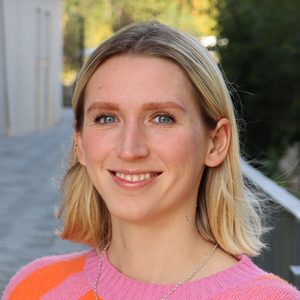
Ella’s doctoral research examines the role of male social care workers in England, with a particular focus on how different groups of men experience care work (including British-born men and those who have migrated to the UK) and how more men could be recruited into the sector. This project is funded by the White Rose DTP and is supervised by Professor Sue Yeandle and Professor Majella Kilkey.