This is a guest commentary and does not necessarily reflect the views of the Centre for Care, its partner organisations or its funders.
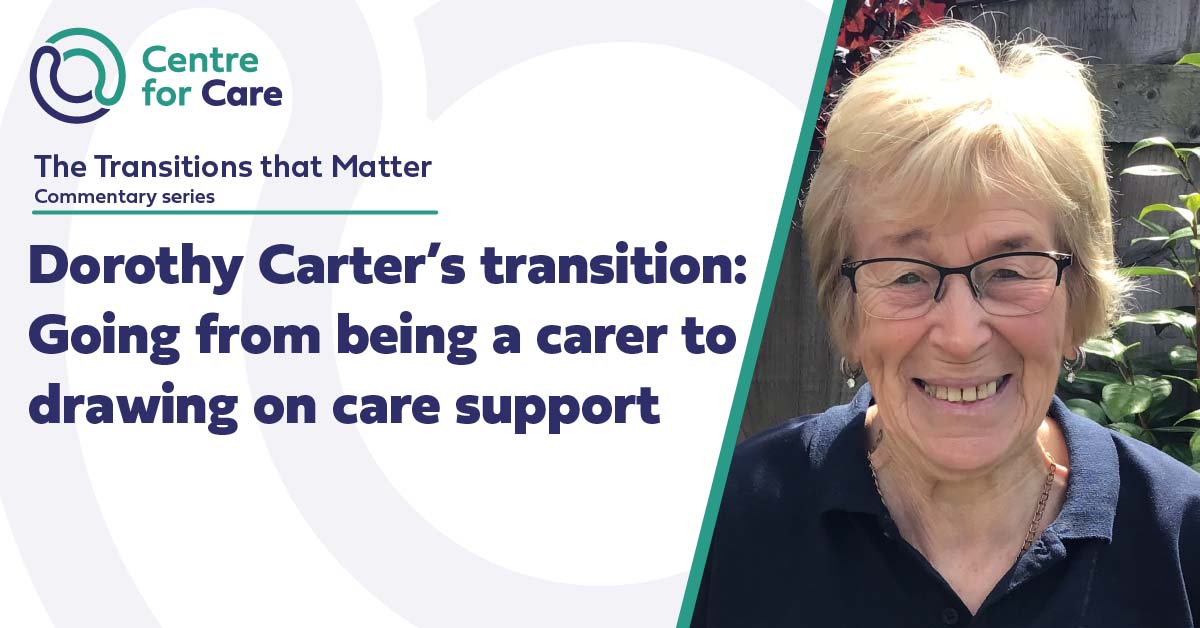
Dorothy was born in the mid-1940s and was a shy young lady with a flare for dancing. She worked for her Local Authority for almost 30 years and later worked for Age Concern – taking up this job was the wisest decision of her life. In the meantime, Dorothy cared for and advocated for her parents and later her husband of almost 60 years. She is now drawing on care and advocacy support from her two adult sons and the health system. She explained how this life transition has affected her.
Dorothy’s husband was diagnosed with diabetes 25 years ago. She assisted him throughout the years in controlling his sugar levels. He had a stroke, which affected his mobility and memory, and she became his registered carer. She said:
“We plodded on for 4 years until he [her husband] had a serious fall in 2024. But just before that I’d been critically ill in hospital. While I was in hospital they asked me what the situation was. I said “I’m a carer.” They said “Oh, you seem to be fine.””
She left hospital without any support. This highlights how carers can end up having a ‘double duty of care’, i.e. caring for oneself and caring for one’s loved one. When this is not recognized and a carer is not supported, it can lead to further difficulties. The hospital staff did not seem to be sensitive to Dorothy’s situation as a carer and were not aware of the support that could be available to her, so they did not advise her accordingly. Therefore, hospital staff ought to be trained better about spotting carers who themselves require care support and about care support that could be available for carers when returning home. Social workers could also be embedded into hospitals to assist carers during the transition back into their home; at the moment this seems to be a postcode lottery.
Dorothy’s husband ended up in hospital in late 2024. He had “fantastic” treatment in the Intensive Care Unit, although sadly he passed away within the same year. Dorothy said:
“The thing about being his carer was that I learnt to stand his corner but still remain calm. But I did have this great mistrust [of the health and social care systems and professionals].”
When asked about Multi-disciplinary Teams and how they work she said:
“If you have a married couple, it should be a single assessment. It’s all very well saying that “we keep the carer informed.” They don’t. There was no communication between departments never mind institutions.”
Dorothy is now undergoing medical treatment and is being supported by her adult sons. She said:
“My worst transition was becoming a ‘cared for’ rather than a ‘carer’. It’s easier to stand for someone else than yourself. I think I got too used to being in control [as a carer]. All of a sudden when it was me, I thought “It’s slipping away.” People’s attitudes to me changed. I was confident before, if I was going to talk with someone on the medical team, I was on a level with them. I went for an eye test recently and the lady asked for my date of birth. When she heard it, she then said “This is a mouse. Please click it when you see the dot moving.” She was surprised that I could use a computer. When you’re ill it’s bad enough, and when you’re older it’s even worse.”
This illustrates how people’s attitudes and societal prejudices about having an illness and being aged can lead to experiences and feelings of disempowerment. Whether it be professionals or/and individuals in the community, we all need to be that much more mindful about how we interact with disabled and aged people.
Dorothy is acutely aware of the current situation with health and social care services and highlighted that dialogue is important. She said:
“I know resources are low and services are under-staffed. It’s not as though I’m asking for a GP appointment every week. I go when I’m desperate. But they ought to ask people what’s going on. I had an appointment last Tuesday. Halfway through I said “Hang on a minute, you’re telling me how I feel. I’m not telling you.” It’s just very patronising. As though they know better. But I know how I am feeling in that moment. Talk to me. Even if we’ve got nowhere, at least we talked.”
Listening is crucial.
Dorothy’s lived experiences illustrate how going from being a carer to a person drawing on care support, along with being aged, can affect a person’s life. Policies and practices ought to better support carers in transition, whether it be returning home from a hospital stay or to becoming a person drawing on care support. Individuals/professionals all need to be more mindful. Listening is very important.
Acknowledgements
Thank you to: Changes Plus for their work and input; and Hayrunisa Pelge for writing the commentary.
Read more on the Transistions that Matter below
The Transitions that Matter commentary series
Summary Report: The Transitions that Matter
Working Paper 4: The Transitions that Matter