This is a guest commentary and does not necessarily reflect the views of the Centre for Care, its partner organisations or its funders.
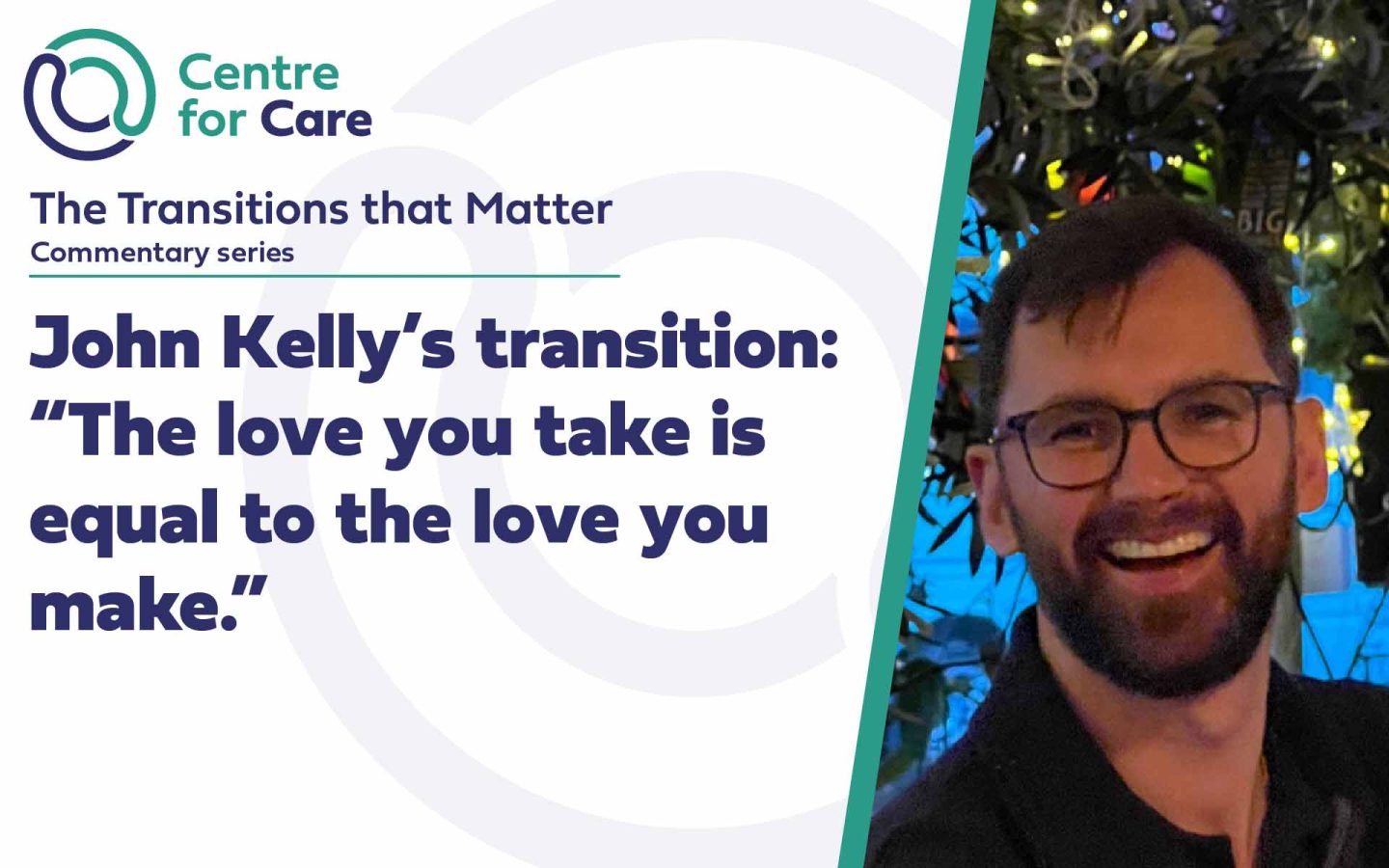
John worked as a UK Commercial Sales Manager, living between Kettering and Liverpool. He travelled throughout the UK, visiting various potential clients for work and to see family and friends at the weekend.
In early 2012 he was driving on the road one cold and crisp Saturday morning and the weather changed to rain, hail, sleet and snow. A momentary break in the weather revealed a wall of red brake lights. Unfortunately, pressing the brakes proved absolutely ineffective. In spite of every effort to avoid the collision, the car slid into another vehicle that had already crashed. He was taken by ambulance to a local hospital.
John was placed into an induced coma. The doctors tried to wake him up twice but could not do so. He had pneumonia. After receiving the last rites twice, the doctors were finally successful in rousing John after 3 weeks. When he did come to, he had difficulties with his memory and struggled to talk and move. His mother and father were both vital in ensuring that John received the care that he needed and deserved. Not least ensuring that he was able to enter a rehabilitation programme that he was previously denied. The reason given was that he was not a resident within the area the hospital was based in. John’s mother had to confront the head consultant. She said:
“So you’re telling me that you are willing to negatively affect John’s rehabilitation because he’s not in the right cost centre for the hospital? His post code makes that much of a difference?”
This caused widespread panic amongst those who make decisions and ensured that the wheels started rolling on a transfer down the motorway to another hospital at home in Liverpool, where he underwent therapy. This commentary explains how the experience affected him and his family, and how John has come to believe in Paul McCartney’s words, that “the love you take is equal to the love you make.”
When John roused from his induced coma, he was in a hospital that was not in Liverpool, where he lived and his parents lived. This was stated as the reason he was not allowed to commence a structured rehabilitation plan – due to financial implications. However, the physiotherapists and nurses were using their lunch breaks to work with John and provide rehabilitation therapy. He said:
“The staff were wonderful and the nurses. The physios were taking me in their own time. That was magnificent.”
There are professionals who go beyond the call of duty, and they clearly made a very positive difference in John’s life.
His parents would drive to the hospital every day to oversee his care and to advocate for him. He said the following about his mother:
“She was my sword and shield. She was everything.”
The presence of a family member/an advocate can be crucial in the process of getting better. It was thanks to his mother’s advocacy that he was finally transferred to another hospital where he was enrolled on an official rehabilitation course. His healing process was slow. He said:
“The improvements I first had were very slow, then quickly increased in momentum. Akin to watching a ball of snow roll down a hill, gathering mass. My improvements are definitely still happening, but are much slower now, to the point that I may be the only one that notices them. It is often like watching grass grow, or paint dry.”
He had to learn various skills again, like going to the supermarket, with a pre-planned menu, using money to buy the required ingredients, returning to the hospital and cooking his own food.
John lost a lot of acquaintances but was very well supported by his closest companions, relatives, parents, and his football club. He said:
“In my experience following the accident, my circle of friends, that was quite large, got a lot smaller. My then girlfriend of the time, who I had been in the passenger seat of the car during the crash, but had emerged relatively unscathed due to my attempts to avoid the crash. She stuck around for 12 months to her credit, but I don’t think I was recovering fast enough for her, so she called time on us. That was tough. But, one thing I can say is that my club never let me down. Everton. EiTC [Everton in the Community] really helped me recover, both physically and mentally. They were fantastic. I loved them anyway. But I love them even more for that.”
John was able to join in community events that the football club held, and this lifted his morale. This included playing in tournaments across the UK and also a community art project that called on the EitC participants to meet weekly with an artist and formulate an exhibition that was scheduled to be exhibited in London. He continues to participate in the events. This illustrates how a football club can also be a place for emotional wellbeing and an environment for care to take place.
John now carries out talks with students training to be doctors, nurses, physiotherapists etc., educating them about his experiences in the health care system and what kinds of factors they ought to keep in mind when working with patients. He is putting into practice Paul McCartney’s words, that “the love you take is equal to the love you make.”
Acknowledgements
Thank you to: Changes Plus for their work and input; and John Kelly for sharing his experiences and for writing this commentary with Hayrunisa Pelge.
More posts