Who is entering care in England, how long do children stay, what kinds of care arrangements do they experience, and how do they leave?
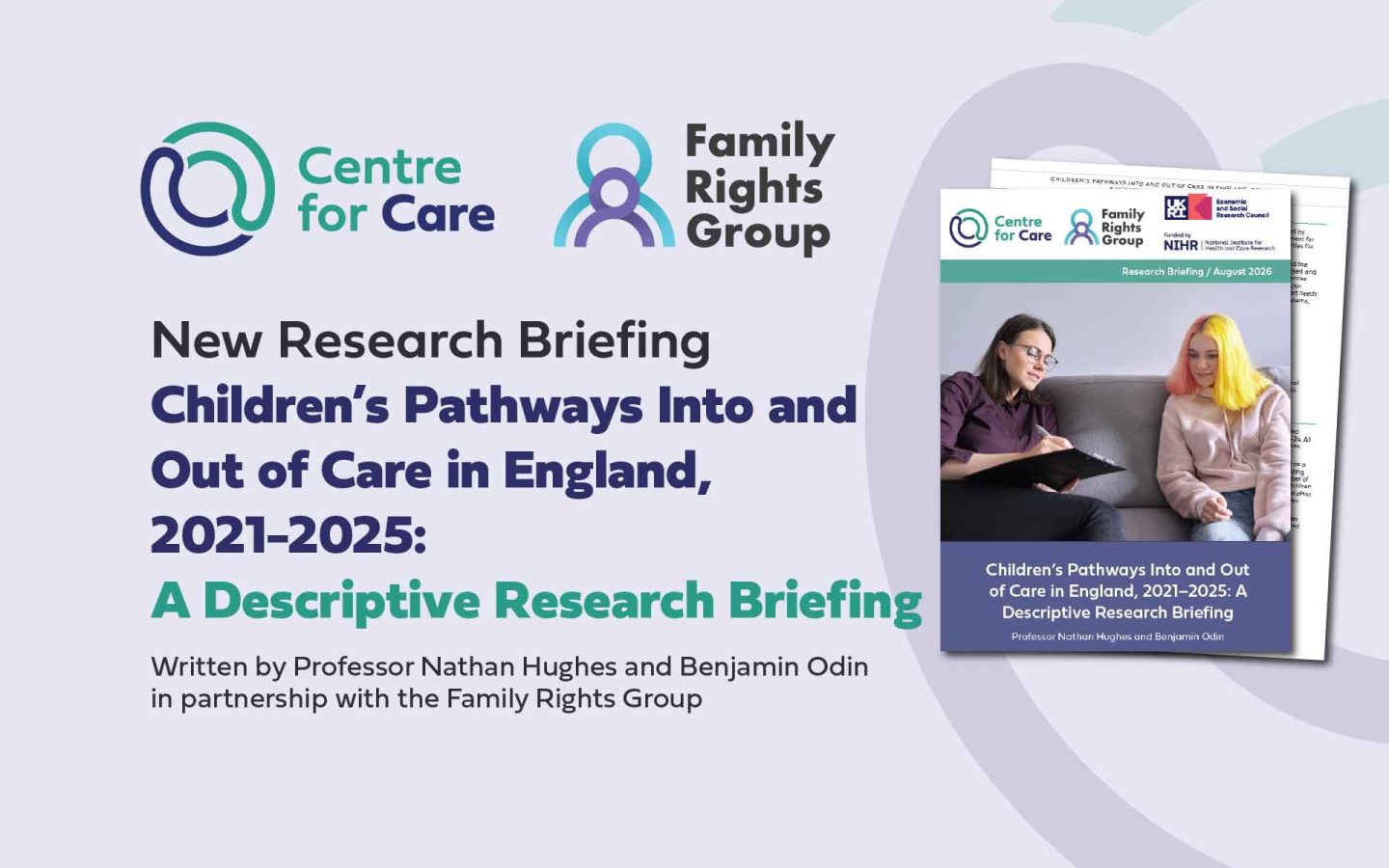
Our new research briefing, produced by the Centre for Care in response to questions raised by Family Rights Group, takes a detailed look at Department for Education data for 2021–2025. It brings together some familiar statistics, but also draws out important changes in the profile of children entering care, the arrangements in which they live, and the very substantial differences between places. Click here to read the full briefing.
Key findings
One of the clearest changes is in who is entering care. There were 32,270 recorded entries in 2024–25, representing around 29,630 distinct children once transfers between local authorities are accounted for. More than half of children entering care are now aged 10 or over, while the proportion aged 16+ has risen from 20% in 2021 to 28% in 2025. Unaccompanied asylum-seeking children are an important part of this changing picture, particularly among older teenage entrants.
There is also a significant change in how children in care are being accommodated. The overall number of looked-after children has changed relatively little, but foster care has declined as a proportion of care arrangements, while residential and supported or semi-independent accommodation has expanded sharply. Between 2021 and 2025, the number of children in these residential and supported settings increased from 11,360 to 17,000 – a rise of around 50% – while kinship foster care has remained comparatively stable and slightly increased in relative importance.
The briefing also highlights how different children’s pathways through care can be. Among those leaving care in 2024–25, 28% had been looked after for less than six months, while the average completed spell was just under two and a half years. While a large proportion of exits occur as young people reach 18, exits before adulthood are disproportionately concentrated among very young children, through routes including reunification, kinship care, special guardianship and adoption. These averages therefore conceal markedly different experiences of care.
Perhaps most strikingly, where a child lives matters enormously. In 2025, local authority rates of children in care ranged from 27 to 184 per 10,000 children – roughly a seven-fold difference – and these geographical inequalities have proved persistent. The briefing describes these patterns but also identifies important unanswered questions about the role of poverty, ethnicity, local services, legal routes and other factors. Further analysis of the child-level SSDA903 data, alongside targeted reviews of evidence on prevention, kinship care, reunification and relational support, could help us move from describing these differences towards understanding where change may be possible, for whom, and under what safeguards.
About the authors

Nathan Hughes is Professor of Adolescent Health and Justice, co-director of CIRCLE – the Centre for International Research on Care, Labour and Equalities – at the University of Sheffield.
He is Deputy Director of the Centre for Care, and lead for the Children and Families theme. This reflects his broad research interests in effective support to vulnerable young people, including those affected by health and developmental difficulties and those within the child protection system.

Benjamin completed his undergraduate degree in Financial Economics at the University of Dundee before being accepted onto the masters program in Health Economics at the University of York where he was awarded with an NIHR studentship. Benjamin then spent several years working in various corporate finance roles in different countries before joining the University of Sheffield as part of the Wellcome Trust PhD program in Public Health Economics and Decision Science. The Wellcome Trust program provides the next generation of Public Health Economists with state of the art training and experience in order to progress the field in a positive and meaningful direction.