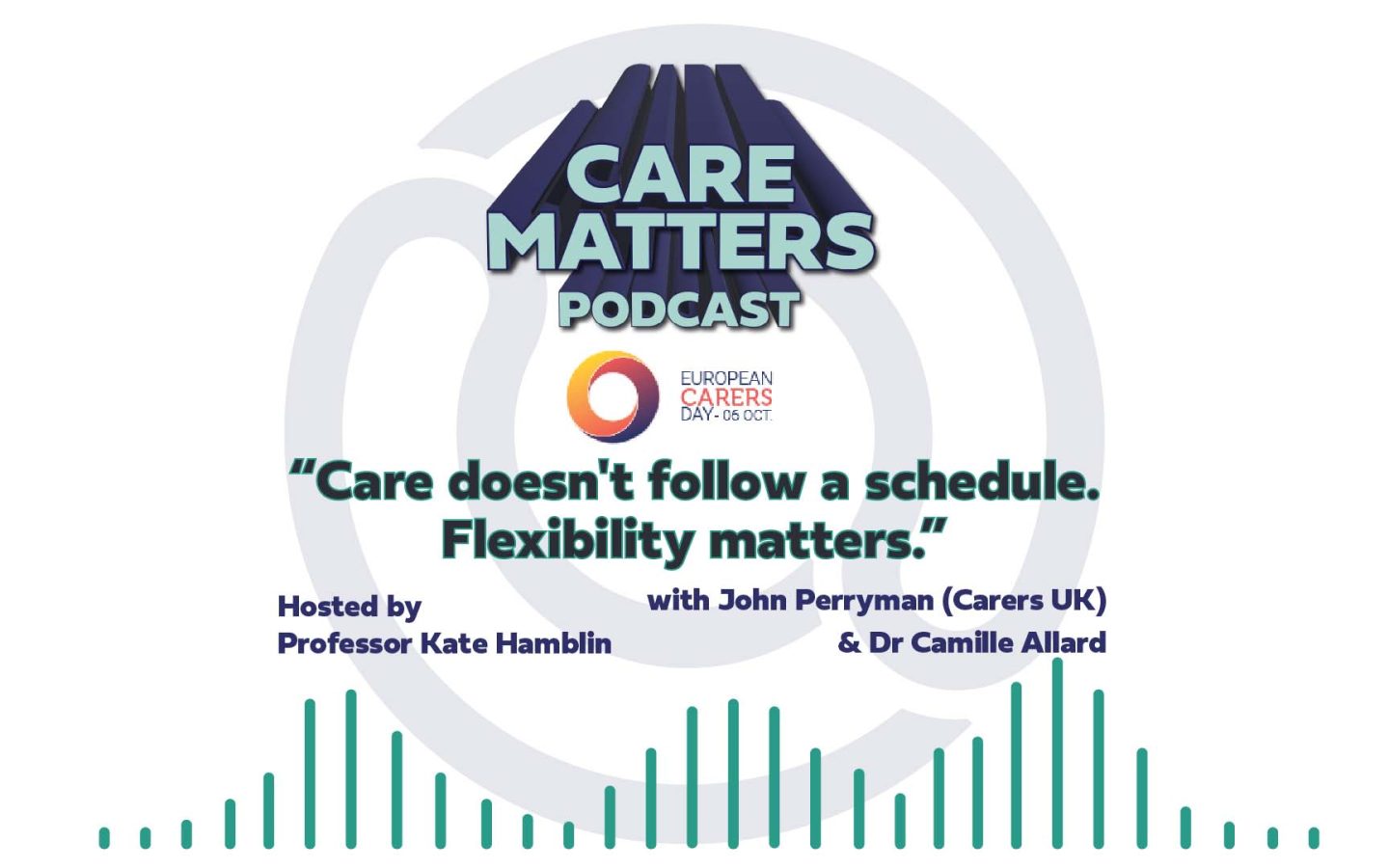
In this episode of Care Matters, host Professor Kate Hamblin explores the European Carers Day 2026 theme: “Care doesn’t follow a schedule. Flexibility matters.” She is joined by John Perryman (Carers UK) and Dr. Camille Allard (University of Milan) to discuss the policy opportunities and practical challenges of supporting working unpaid carers.
Press play below to listen to this episode:
Key Discussion Points:
- The Scope of the Issue: New Carers UK research shows that 1,500 people per day—over 1 million in the last two years—are forced to leave employment due to the challenges of balancing paid work with unpaid caring duties.
- The Case for Statutory Paid Leave: While the 2023 Carers Leave Act granted 5 days of unpaid leave, advocates emphasize that unpaid leave is financially unviable for many low-income workers. Carers UK is advocating for 5–10 days of paid statutory leave, noting that employers offering this report minimal usage costs (averaging 2.5–3 days per year) and higher staff retention.
- Employer Innovations: Research highlights effective workplace measures beyond leave, including Carer Passports (which preserve adjustments across line managers), job sharing, hybrid models, and internal carer support networks.
- Systemic Reforms Needed: Panelists stressed that employment rights must be backed by wider ecosystem reform—specifically addressing Carer’s Allowance earnings limits, underfunded social care, and NHS administrative burdens on informal carers.
A message from our partners, Eurocarers
We desperately need to offer carers a more meaningful, comprehensive, and flexible package of support if we are going to ensure that carers can manage to stay in employment, avoid poverty risks, and worsening mental and physical health.
Our new paper maps the state of play in 2026, four years since the transposition deadline and includes valuable insights from our member organisations across 26 countries.
We look forward to continue to work with the European Commission, national governments, employers, and trade unions to shape a more caring society together.
See our new position paper here: https://eurocarers.org/ecd
Related links
Carers UK (2026) Balancing work and care: a critical issue
Carers UK (2026) The ‘tipping point’
Carers UK (2024) Taking the next steps for working carers
DBT (2026) Qualitative research with unpaid carers
About our speakers
Professor Kate Hamblin (host)
Kate Hamblin is Professor of Social Policy and Director of the Centre for Care. She joined the University of Sheffield in 2018 to work on the Sustainable Care programme. She is the UK Networks and geographical lead for the North and East-Midlands in the IMProving Adult Care Together (IMPACT) evidence implementation Centre. She is also the Policy and Practice Liaison lead for the NIHR School for Social Care Research at the University of Sheffield.
John Perryman, Head of Policy and Public Affairs (Work, Care, Equality), Carers UK
John joined Carers UK in December 2018. As Head of Policy and Public Affairs he contributes to the organisations policy and research development, campaigning and influencing strategy and parliamentary engagement. Prior to joining Carers UK, John spent five years working on policy and research issues at the UK Commission for Employment and Skills, before joining Age UK to work on issues relating to older people and social care. John played a leading role in the passage of the Carer’s Leave Act 2023, and leads Carers UK’s policy work on issues relating to work and care.
Camille Allard, Research Fellow, University of Milan
Camille Allard joined the University of Milan in 2024, where she teaches policy and social issues related to care and has collaborated on different research projects on work, generational change, and youth-led activism. Before that, she spent three years at the University of Birmingham and completed a PhD at the University of Sheffield on workplace support for carers in the British context, as part of the Sustainable Care programme. In particular, her thesis examined the introduction of employer-led carer’s leave in different organisations, its impact on carers’ wellbeing, carers’ experiences of combining work and caring responsibilities, and workplace inequalities. Her research, which focuses on the sociology of care, wellbeing, and work from a critical and feminist perspective, has been published in internationally peer-reviewed journals, and her thesis informed the consultation that led to the passage of the Carer’s Leave Act 2023 in the UK.
Key publications on the topic of carer’s leave, carers’ voice, and workplace support:
Allard, C. (2025). How Care Inequalities are Reproduced in ‘Carer-Friendly’ Jobs: The Case of Employer-Led Carer’s Leave. Work, Employment and Society, 39(4), pp. 814-835. https://doi.org/10.1177/
Allard, C.(2023). Speaking up as a working carer: working carers’ use of voice and struggles for representation in the workplace. International Journal of Care and Caring, 8(3), pp. 418–436https://doi.org/10.
Allard, C. (2022). Taking the time to care? A study of employer-provided paid carer’s leave in three organisations in the UK. PhD Thesis. University of Sheffield. OAI ID: etheses.whiterose.ac.uk:30589
Allard, C., and Whitfield, Grace J. (2023) Guilt, Care, and the Ideal Worker: Comparing Guilt Among Working Carers and Care Workers. Gender, Work & Organization, 31(2), pp. 666-682 https://doi.org/10.1111/gwao.