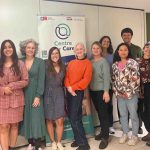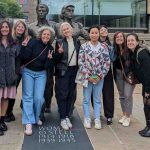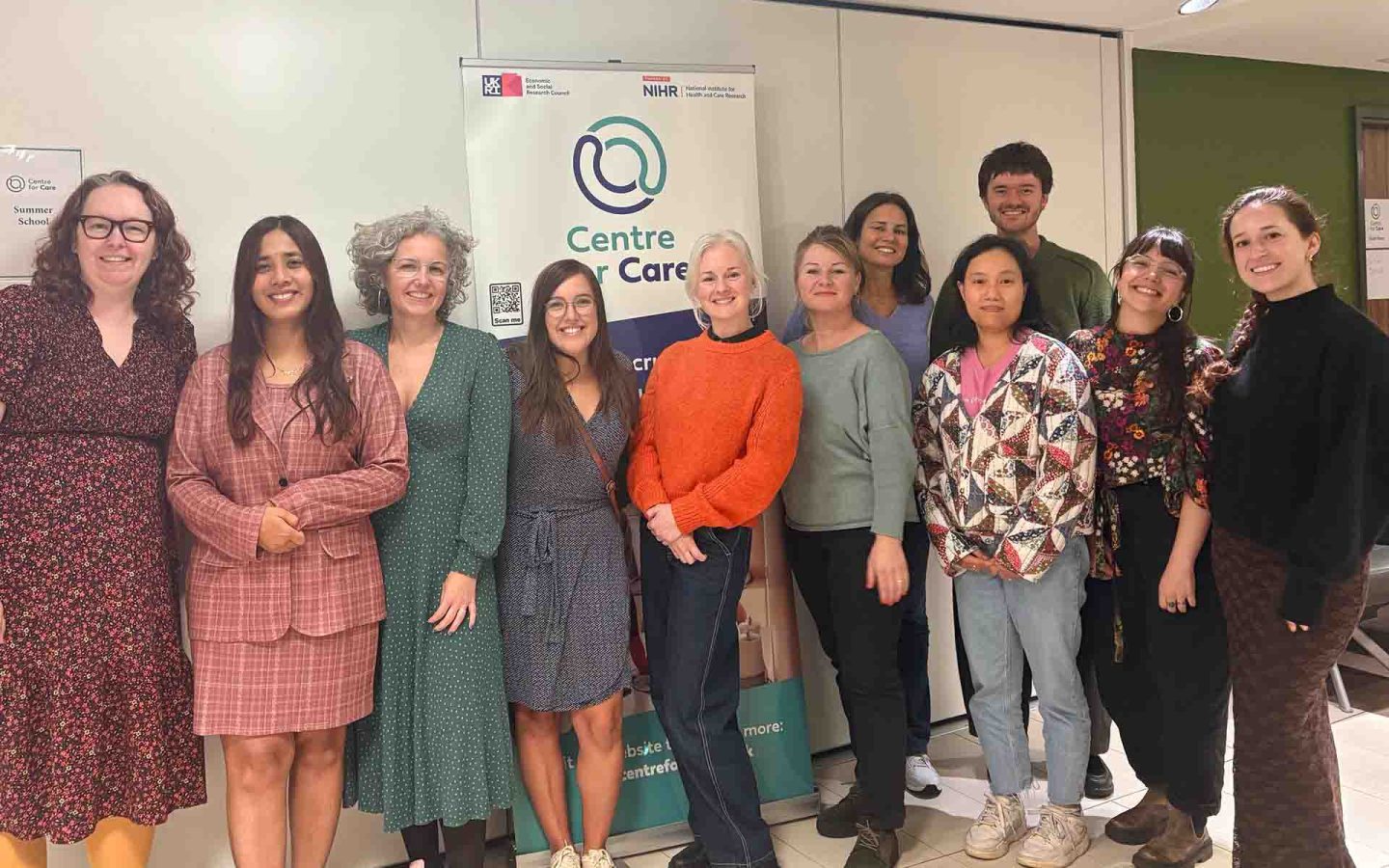
In September 2026, 11 PhD scholars from across the globe came together in Sheffield, UK for The Centre for Care’s Summer School. Over the course of a week, they shared their research projects and experiences with each other, learned about different theoretical approaches to care, participated in workshops on methodologies to studying care, and more. Here, the cohort reflects on how their experiences at summer school opened up their research perspectives and challenged their approaches to research on care.
Bárbara Zimmerman, PhD Researcher, HAWK and University of Vechta, Germany
The Summer School at the Centre for Care was one of the most important experiences of my PhD journey. I came to Sheffield working on participation opportunities for migrant mothers of disabled children in Germany and left with renewed confidence in my research and a beautiful global care-research family.
When I left Germany I was somewhat uncertain, how much (negative) feedback – hello imposter syndrome! – would I receive, and how much would I need to restructure my work. After all, I am at the final phase of my research. But instead of having to rebuild everything, I gained confidence in my theoretical framework and empirical results. Coming home to complement my writings with some new references and perspectives felt not like an excessive demand, but a real joy!
I remember with pleasure the many important sharing with the group and the theoretical discussions, especially with Charlie. We were showing our theories to each other like little kids showing their glitter stickers. I am very grateful for connecting with Akemi Nishida through him – her concept of “messy dependency” is an important complement to my research about participation opportunities in the entanglements of care, disability and migration.
I left Sheffield with deeper confidence in my work and the deep joy of working in a very careful setting – thanks especially to Kelly, Sarah, Matt, Nathan, Kate and Majella for creating this nurturing matrix and accompanying us through the week.
Catalina Ganga-León, PhD Fellow, Bremen International Graduate School of Social Sciences (BIGSSS), University of Bremen, Germany
I am in the final months of my PhD and it has been a period mainly marked by stress and uncertainty. For the first time, I have experienced imposter syndrome and it has been very difficult to regain confidence in my knowledge and abilities. At times, it becomes inevitable that a part of me wonders whether I might be getting it all wrong. Faced with this fragility, being accepted onto and taking part in the Centre for Care’s Summer School at the University of Sheffield was simply a comfort to my heart and a little boost of encouragement for the final months.
My PhD project focuses on a largely unexplored area within care studies: the emotions of carers for older adults and how regulating these emotions is an important part of their work. Exploring this topic has been my task over the last four years, during which I have analysed the reality of my home country, Chile, and of my host country, Germany.
The summer school allowed me, first of all, to share my work and feel that what I am doing is important, valuable, and also rigorous. I received feedback from my mentor, Kate Hamblin, as well as comments from other colleagues, which helped me to strengthen my work: to delve deeper into the concept of ‘theory’ when using a grounded theory approach, and to explore further what is meant by ‘emotion’ and ‘feeling’ in the context of care. The importance of conceptual clarity is one of the key lessons I have taken away from the summer school.
Furthermore, the conversations with my fellow participants were always a source of comfort and reassurance. Over the course of a week, we created a caring and respectful space. Our curiosity around care, and its fundamental role for humanity and the environment, was what brought us all together. Thanks to the efforts of those who organised and ran the summer school, I returned to Bremen with renewed motivation, thinking about how to strengthen my work but no longer doubting it.
Dimpi Handique, Doctoral Student, Central University of Rajasthan, India
I arrived at the Centre for Care Summer School in Sheffield, somewhere between coded categories and a theory I hadn’t yet fully named. I had left behind a chapter draft still open on my laptop and a week of work at home trying to hold Phase 1 and Phase 2 together into something coherent. It felt risky to step away from the analysis when I was still so deep inside the data, but I’m glad I went anyway.
Every morning, I walked the same road from my room to the workshop room, taking the same turns and the same stretch of pavement, alongside people I had only just met but who already felt easy to walk beside. There was something about that walk, that room, and that repetition that felt oddly close to the PhD itself; new faces, yet somehow a place I settled into very quickly. My research began as a study of changing masculinities in Assam, India, and slowly became something else; a study of who gets to give care, who is trusted to receive it, and who is quietly written out of both. Sitting with scholars working on disability, aging, violence, migration, and institutional power, I kept noticing how often care appeared as something else entirely: provision, protection, silence, even control. It made me less certain of my own definitions, but in a useful way.
What stayed with me wasn’t only the theory or methodology. It was hearing people name the same frustrations I’ve been carrying alone for three years; the loneliness of fieldwork, the slow grind of writing a chapter that keeps changing shape, and the pressure to sound certain about work that is still becoming itself. Naming that together felt like relief. I’m going back to my thesis with the same data, but less tidy in how I hold it. If care can look like a father’s protectiveness or a man’s silence about what migration cost him, then perhaps the real work isn’t defining care more precisely; it’s learning to recognize it in forms we were never taught to see.
Emlyn Foxen, Doctoral Researcher, Department of Criminology, Northumbria University, United Kingdom
As an early-stage PhD student about to begin my data collection, this summer school could not have come at a better time. I am studying economic abuse, a form of intimate partner violence and coercive control that disproportionately affects women. My project explores how unpaid care work – primarily, I thought, the doing of unpaid care work by women – impacts women’s experiences of economic abuse. This includes interrogating how coerced unpaid care work and the refusal of men to help with care work makes women vulnerable to economic abuse and compounds their economic exploitation and dependency.
Speaking with my fellow students at the summer school provided a much-needed reminder of what may seem obvious: care is a two-way street, in that we both care for others and need care for ourselves. Conversations with my colleagues and a workshop on care theories challenged me to expand how I am thinking about care in my PhD, by reiterating that care researchers must not invisibilise those on the receiving end of care. As a result, I have adjusted the interview questions I plan on asking victim-survivors of economic abuse, and incorporate a more explicit focus on the experience of victim-survivors who have been cared for by others. This includes disabled women and women with short-term caring needs. Disabled women in the UK, I recently learned, are nearly twice as likely as non-disabled women to experience economic abuse, another important reminder that both caregiving and being cared for are significant dimensions of economic abuse worthy of scholarly attention.
I am so grateful for the opportunity to be challenged in such a supportive environment and to have had the privilege of learning from many brilliant scholars. I am moving into the next phase of my research feeling more confident and inspired than ever.
Hailey Leah Rheault-Huber, PhD Candidate, Department of Sociology, Örebro University, Sweden
As a PhD candidate approaching the internal review of my monograph thesis, I questioned whether this was the “right” time to attend a summer school. With the demands of finishing a PhD, alongside my ongoing struggles with time management, taking a week away from writing felt difficult to justify. Yet I am incredibly grateful that I did.
Alongside discussing theoretical tensions between care, feminist, and disability scholarship, I particularly appreciated how the Centre for Care encouraged us to consider what our research might contribute beyond academia. Having previously critiqued how sociologists can hold knowledge hostage from the publics they study, I welcomed the opportunity to reflect on my own responsibilities: what might my findings contribute to public policy beyond documenting intersecting inequalities among parents caring for autistic children in Canada and Sweden? Drawing on my findings, I began to see the potential for information-broker roles to support parents following diagnosis, reducing some of the responsibility placed on them and creating more space to centre autistic children within their care trajectories.
As I enter the final stages of revising my concluding chapter, I am carrying this renewed sense of connection and purpose with me. I am grateful to contribute to this field alongside scholars who have reminded me why this work matters. Finding spaces that foster belonging in research can be difficult, and for me, it was better late than never to find my enclave within the care research community.
Ida Doherty, PhD Fellow, King’s College London, United Kingdom
Attending the Centre for Care Summer School was a valuable opportunity to step outside my own discipline and spend time thinking more deeply about care, inequality, power and social change. Hearing perspectives from researchers working across disability studies, care ethics, intersectionality, social justice and life course research challenged some of my assumptions and introduced new ways of thinking about families’ experiences. I came away with a stronger appreciation of the opportunities, but also the challenges, of bringing together ideas from different theoretical traditions.
Presenting my PhD research and discussing it with peers, academics and mentors prompted important reflection on the direction of my work. In particular, conversations about antiracist practice, cultural competence and institutional racism encouraged me to think more critically about how structural inequalities are understood and addressed within family-focused mental health support. The Summer School also encouraged me to reflect on my own positionality and the responsibilities that come with researching and working within systems that hold power over families’ lives.
One of my biggest takeaways was thinking about care not only as something we study, but as a way of doing research. Discussions about ethics, discomfort, harm, repair and healing resonated strongly with me and have prompted me to think differently about my thesis and future research. Alongside meeting a fantastic group of researchers and practitioners, I left feeling energised, with new ideas, new connections, and greater confidence to ask difficult questions about racism, power, and care, while keeping families’ experiences at the centre of my work.
Jo Hatcher, PhD Candidate, Social Equity Research Centre, RMIT Melbourne, Australia
The attitude of care and openness of everyone involved in this year’s Centre for Care Summer School created a space for ideas to flow, for connections to be made and for thinking to be challenged. Conversations moved fluidly between disability and violence, the economic invisibility and precarity of unpaid care, the physically and emotionally demanding nature of care work, ageing and the life course, and the two-way, relational nature of care itself.
That same connectivity showed up in the practical, lived experience of doing this research. Hearing other students describe their struggles with recruitment, the toll of emotionally demanding research, the methodological knots of measuring something as relational as care, gaining ethics approval for high-risk work, and the tensions of collaborating with industry, all while attending to their own caring responsibilities. I realised these weren’t isolated frustrations unique to my own project, they were shared global challenges and naming them collectively was a form of validation I hadn’t expected to need.
Intellectually, the experience also cracked open my sense of the field’s breadth. I came away with a long list of papers and new theoretical frameworks to explore, and the chance to see how others are embedding care theory into their empirical work. But I also felt encouraged that you don’t need to be a theory expert to contribute theoretically.
Altogether, the summer school didn’t just add to my knowledge of care theory: it reinforced how I think research on care should be conducted, relationally, collectively, and with the same ethics of attentiveness that we ask the care system itself to embody. And I learned that ultimately, sometimes the most important theorising happens not in the seminar room but over a lane of tiny bowling balls, in the company of people who simply get it. I am incredibly grateful for the experience and to everyone involved.
Mai Trinh Nguyen, Doctoral Researcher, School of Politics and Global Affairs, City St. George’s, University of London, United Kingdom
The major takeaway from the Centre for Care Summer School, for me, is summarised in one word: positionality. As a Vietnamese scholar in the United Kingdom who works remotely and does not see many colleagues, let alone someone working on the same topic, this unique opportunity resembles a mirror for me to look at myself and what I’m doing in a new light.
I started my journey in care and care research from a Confucian standpoint: care as the ultimate duty, fulfilling the meaning of our existence, mainly in the familial context. Caring for your child, in sickness and in health, is called parenting, and caring for your aging parents, for better or for worse, is called filial piety. The word care in my language carries a different weight. Moving to the UK, studying in the European context and working directly in the care sector, has hugely impacted my research and personal point of view on care. My time at the Summer School alongside ten other scholars doubled that impact. What I learned in one week had the same value as years of living and working in the UK.
Talking about my own study and others’, my academic horizon expanded significantly. I learned that care is not merely a duty, or a domestic or economic domain, care is a site for resistance where we nurture one another as a community, across the borders of ethnicity, gender, citizenship, in the face of systematic struggles and inequality, as well as in spite of one’s circumstance, for example, their relationship or disabilities. Care is transactional, but the line between the caregiver and recipient is blurred, and that is beautiful and human. We are bound by the constant reminder of how vulnerable we are, and that we need others to make our time here on Earth worthwhile.
At the Summer School, we also acknowledge our vulnerabilities as academics and the challenges they present. We learned from our projects to tread lightly, so that we do not cause any harm to either the people we talk to or ourselves, but also to stride forward firmly so we can make a meaningful contribution to the field and honour those we represent. We are not only researching care, we are also researching with care.
My reflection will end with a quote by the Roman scholar Cicero, ‘Omnia mea mecum porto’ – I carry all that is mine with me. From now on, thanks to the Centre for Care Summer School, I carry greater weight and value with me, and I could not be happier to carry it.
Vjollca Haxha, PhD Candidate, Health and Society Studies, Malmö University, Sweden
Against the backdrop of my research on how parents of children entitled to support under LSS (The Swedish Act concerning Support and Service for Persons with Certain Functional Impairments) navigate welfare systems, the summer school pushed me toward a broader question: who gets to decide how we care for one another. This question is urgent at a time when the caring state is retreating from its promise of support, leaving many families with lifelong caregiving responsibilities and without sustained public assistance.
The summer school encouraged me to think beyond the traditional separation between care research and disability studies, and to explore what becomes possible when care is understood not only as a response to dependency but as a practice capable of reshaping unequal relations. Human rights frameworks such as the UNCRPD place democracy and equality at the centre of rights claims and can be seen as forms of transformational care: practices that reconfigure relationships, dismantle paternalism, and challenge ableism. The state and its social policies remain crucial for enabling such transformation.
In this light, Eva Feder Kittay´s call for “a knife sharp enough to cut through the fiction of independence” becomes especially resonant. Yet the knife must also cut through the norms that obscure how dependence is shaped, valued and regulated. If care is a species activity that maintains, continues, and repairs our shared world, research must continue to engage families in imagining what a caring and equitable world requires. It is one shaped through practices rooted in relationality, equality and collective responsibility. This includes how families themselves break through prescribed roles by engaging in interdependent care for one another.
The summer school was a real treat. This year’s doctoral fellows shared incredibly innovative and impactful projects together. Their projects spanned family relationships, disability, paid and unpaid care, migration, digital technologies and welfare systems. Despite differences in settings and research questions, there was much shared ground: similar methods and theoretical approaches; common practical and ethical dilemmas; a shared emphasis on lived experience and coproduction; and a commitment to understanding and addressing inequalities in care – as well as recurrent challenges faced in the doctoral research journey. Students joined both a summer school cohort and a wider Centre team, in which care research is at the heart of daily work and discussion.
This was the third and final summer school supported through our initial Economic and Social Research Council funding. We are grateful that this funding has enabled us to bring doctoral researchers together from across the world over three years. Our thanks also go to everyone who has contributed as a student, mentor, speaker or organiser. Building connections among people researching care has been a valuable part of the Centre’s work – and so we hope this will not be our last summer school.
Professors Nathan Hughes and Matt Bennett, Summer School 2026 Chairs